
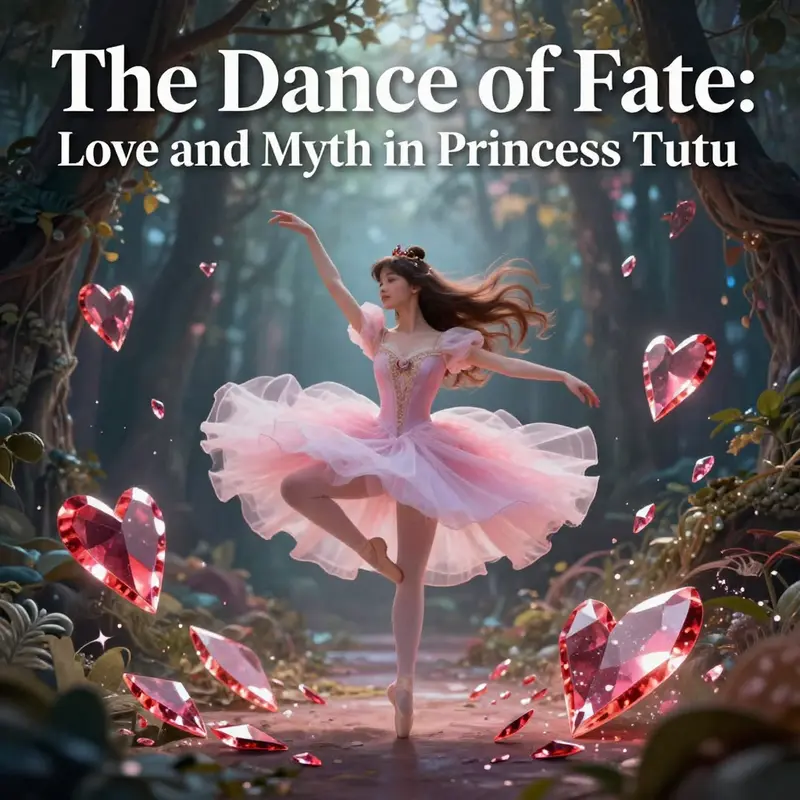
In the world of animation, few stories capture the depth of emotion and the intricacies of fate as profoundly as Princess Tutu. This enchanting tale unfolds through the intertwined destinies of Princess Tutu and Mytho, a love story painted with the brushes of myth and symbolism. As we delve into the resonant themes of their connection, we will explore how their relationship embodies a rich tapestry of mythological elements and the significance of heart shards. Each chapter will illuminate these aspects, revealing how they resonate beyond the confines of the screen to share lessons relevant to business owners and creators alike.
When Myth Meets Heart: The Tragic Ballet Between Princess Tutu and Mytho
When Myth Meets Heart: The Tragic Ballet Between Princess Tutu and Mytho
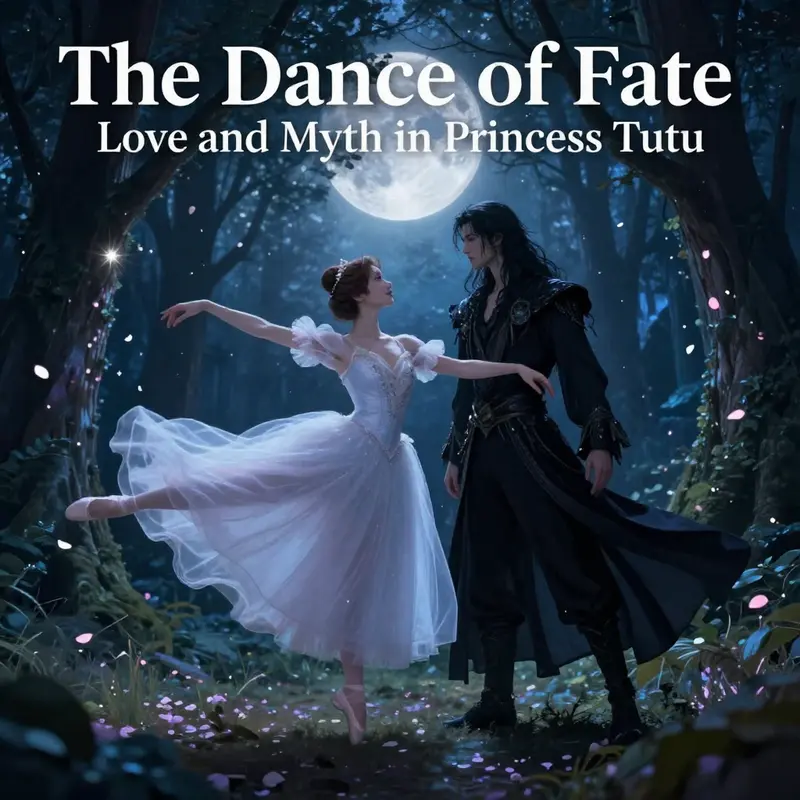
At the center of Princess Tutu lies an ache disguised as a fairytale: a prince whose heart is broken into pieces, a duck who is given the power to become a fairy-tale heroine, and a storyteller whose unfinished ending insists on being told. The romance between Princess Tutu and Mytho is never simple romance. It is a choreography of fate, language, music, and sacrifice, a relationship written into the bones of a story and then questioned from within. This chapter follows that slow, heartbreaking pas de deux — how two souls meet across the space where narrative binds reality, how love grows in silence, and how the possibility of confession becomes the very thing that threatens to dissolve the bond.
Mytho’s first breaths in the series are already staged as absence. Once a prince whose love and courage were total, he sealed his own heart inside the raven to protect others. The result is a beautiful and fragile figure: he dances with the elegance of a practiced performer, yet he moves through the world like a ghost. Faikia, the blacksmith who finds him, offers shelter and a name: Mytho, echoing myth and legend. That naming is telling. It frames him not only as a person but as an idea — an emblem of narrative possibility and narrative loss. To be named Mytho is to be half a character, half a motif.
Ahiru, the awkward duck who transforms into Princess Tutu, enters Mytho’s orbit as both rescue and rewiring. The storyteller’s ghost gives her a necklace; when she wears it, a clumsy dancer becomes a fairy-tale heroine whose choreography can uncover heart-fragments, restore memories, and stitch the seams of a damaged fate. Their first encounters feel like rehearsals: tentative, repetitive, and increasingly intimate. Through dance, they discover the contours of one another’s loneliness. Through music — classical scores that echo Swan Lake and other ballets — their movements translate what words cannot. Ahiru’s earnestness and Mytho’s muted wonder create a chemistry that is tactile and shy. It is a love that grows in the pauses between lines, a tenderness cultivated in the small mercies of everyday support.
Yet narrative rules loom like stage directions that cannot be ignored. The storyteller’s manuscript contains an almost cruel clause: if Princess Tutu, the heroine of the tale, ever confesses her love to the prince, she will vanish into light. This device converts a classic romantic dilemma into a philosophical trap. The series uses it to explore what it means to love well: is it better to confess and risk destroying the beloved, or to sacrifice one’s own fulfillment to preserve another’s life and story? The dilemma makes love an ethical act as much as an emotional one. Ahiru’s choice becomes a moral choreography — each decision she makes is a step that either preserves Mytho’s safety or brings her closer to oblivion.
The relationship’s complexity deepens with the revelation that the Raven and Mytho are linked, and that Rue — a talented ballerina who once loved Mytho — becomes the Raven when the story’s darker currents take hold. Rue mirrors Ahiru in tragic ways. Both are compelled by feeling, both are shaped by performance, and both must navigate an existence where identity and role are nearly indistinguishable. Rue’s transformation into the Raven draws attention to the series’ central paradox: characters are both authors and prisoners of the stories they enact. Mytho’s heart fragments are not simply MacGuffins. They are the traces of selves he cannot access, shards of agency scattered by the obligations of a plot that insists on tragedy.
Ahiru’s devotion becomes the engine that questions that plot. She is not a tragic heroine resigned to destiny. She is relentless, foolish, and honest. She gives up her comforts, braves monsters, and performs acts that reveal both ingenuity and vulnerability. Each heart fragment she retrieves is a scene in which affection, courage, and interpretation intersect. That process reframes love from a single confession into a series of actions: listening, rescuing, staying. In a story that treats speech as dangerous, deeds themselves become language. Ahiru’s dances are confessions without words. They are pure communication, a steady insistence that the prince — and the world — can be whole again.
But Mytho remains ambiguous, not merely distant. Without a heart, he cannot fully remember or feel. He responds to Ahiru with a fragile curiosity and a capacity for beauty, yet he lacks the impetus to name his own attachments. His silence is not cruelty; it is a symptom. When fragments return, glimpses of warmth surface, but each shard recovered is a test. The drama lies in whether a love that blossoms in incomplete reciprocity can survive when the missing parts return. Does love founded on caretaking and mystery persist when the other becomes whole and autonomous? The series resists easy answers. It shows that restoration can be disorienting. When Mytho regains aspects of his heart, he is confronted with the memories and responsibilities he had been spared. Reunion is dizzying, and love has to find new terms.
Narrative authority plays a crucial role in how their story unfolds. Faikia, Rue, the storyteller, and other figures each hold pieces of the tale’s authorship. Sometimes they act as allies, sometimes as obstacles. Faikia’s eventual decision to rewrite the story is a pivotal moment. He shifts the narrative’s center from inevitable tragedy to possible redemption. That choice reframes the romance as not only personal but ethical: love must be defended not just from enemies but from the story itself. In a meta-sense, Princess Tutu is about reclaiming the right to alter myth. The characters refuse to be bound by a script they did not choose.
This rebellion against preordained endings culminates in the delicate, wrenching moment when Mytho asks for the final heart fragment — the blood-red pendant that symbolizes the last piece of himself. Ahiru’s refusal to hand it over is complex. She fears losing the identity she has grown into through her role as Princess Tutu. She fears that without the pendant, the image of the perfect princess will fade and with it her significance. This fear exposes an often-overlooked aspect of love stories: the self-interest woven into sacrifice. Ahiru does love Mytho, but she also clings to the narrative that gave her meaning. Her decision to leap into the lake — to become a pure light and thereby force the pendant back to Mytho — is both an act of desperate altruism and an anguished admission of inability. It underscores how love can be messy, how courage can coexist with selfishness, and how endings sometimes demand annihilation as the only path to repair.
The finale does not provide tidy closure. Mytho’s restoration is not a clean victory. The world remains altered by the choices made. Ahiru’s fate, Rue’s sorrow, and Faikia’s authorship leave scars and lessons. Yet the concluding notes suggest a hopeful redefinition: myths can be rewritten by those who live them. The series insists that love’s highest act might be to step outside the script to allow another to live fully, even if that act destroys the lover’s role in the story. In this sense, the romance between Princess Tutu and Mytho becomes a study in ethical imagination. It suggests that true love requires both the willingness to confess and the capacity to step back when confession would harm.
Beyond narrative mechanics, the relationship resonates because it is staged with palpable artistry. Ballet and classical music are not mere decorations; they shape how affection is expressed. Dance allows for a vocabulary of touch, timing, and posture that replaces verbal declaration. Audiences watch as two figures learn a private choreography: a look held a beat too long, a hand extended and accepted, a fall caught and made whole. The visual poetry aligns with the story’s thematic insistence that some truths are best spoken without words.
Ultimately, the dance between Princess Tutu and Mytho matters because it reframes what we expect from love stories. It does not promise a gilded ending. It demands difficult ethical choices and shows that love can be a source of both healing and pain. It asks whether a story must end as written or whether those who love within it may become its true authors. Through a careful weave of music, myth, and movement, the series offers an answer: love is not merely a confession. It is a commitment to reshape the narrative world that contains the beloved, even if reshaping requires erasing oneself.
For those who feel the pull of balletic myth and the moral knot of forbidden confession, this saga holds an invitation. It asks viewers to imagine what happens when legends are challenged by tenderness, when silence becomes language, and when heart fragments recovered do not simply restore the past but force the characters to make new promises. If you want to see this delicate interplay of dance, story, and love, the series can be experienced in its original form through streaming platforms. For a sense of the classical inspirations that frame the show’s choreography, explore collections of Swan Lake-themed costumes such as Swan Lake costumes to see how the ballet motifs shape character and emotion.
External source: For direct access to the anime, you can watch Princess Tutu on Crunchyroll (https://www.crunchyroll.com/series/gy13685917218841314763/princess-tutu).
Mourning a Myth in Motion: Mythological Currents in Princess Tutu and the Design of Mytho
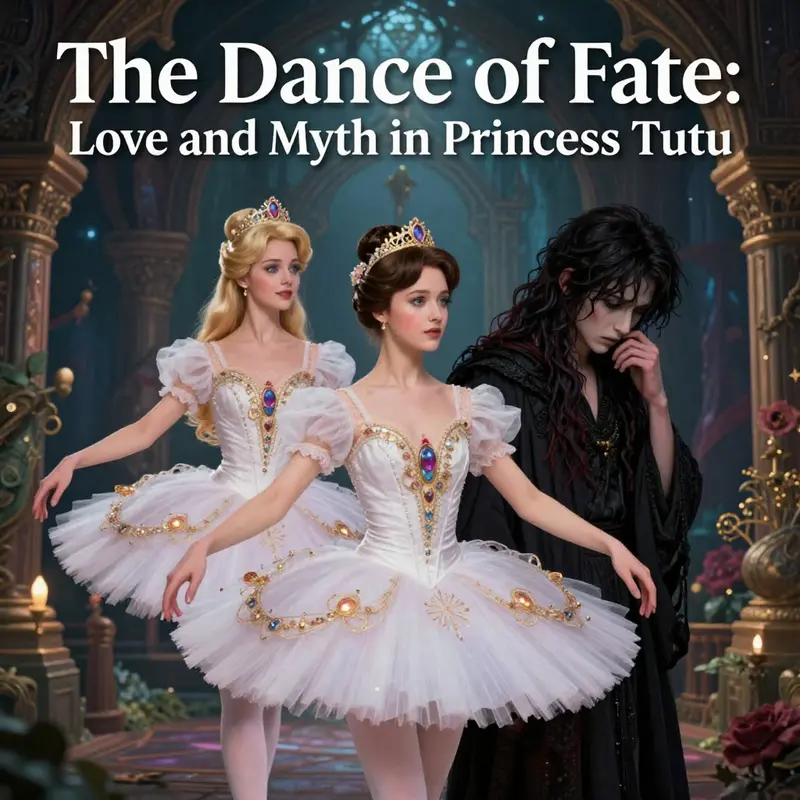
Myth and motion intertwine so tightly in Princess Tutu that the series feels less like a television arc and more like a ceremonial rite performed in clockwork. The show invites viewers to read its visuals, music, and character trajectories as a grand myth reincarnated inside a modern fairy-tableau. At the heart of this mythic ecosystem stands Mytho, a prince whose very form is a ledger of loss and longing. He enters the town of Gold Crow through a veil of melancholy, with a raven’s wing folding into the silhouette of a dancer’s grace, a living paradox that immediately situates him along the fault line between worlds. Mytho’s heart is not simply missing; it is fractured into four shards scattered across different corners of the narrative universe. The broken heart becomes a literal object and a spiritual problem, a wound that must be mended not via force but through a patient, almost liturgical restoration of trust, memory, and identity. This is where the show’s mythic engine hums most clearly: the desire to transform brokenness into a form of beauty and to redraw a fate that seems already written.
From the first frames, Mytho’s story is anchored in a recognizably mythic logic. He embodies the tragic prince archetype found in antiquity and fairy tale alike, a figure who originates in sorrow and who, paradoxically, awakens through acts of care rather than conquest. The duality of his existence—human vulnerability on one side and a raven’s presence on the other—serves as a visual and symbolic cue to the liminal spaces mythologies love to inhabit. In many traditions, the raven is a creature of thresholds, a guide between life and death, civilization and wilderness, fate and choice. Princess Tutu makes this midpoint literal in Mytho’s design, so that his body is a bridge between two kinds of knowledge: the historical memory of a prince and the present tense of a heart in recovery. The effect is not merely aesthetic. It is epistemic: to see Mytho is to be reminded that identity, like myth, is never a finished artifact but a work in progress, continually retouched by need, loss, and the slow patient work of restoration.
The character design itself is a study in mythic typography. Mytho moves with a dancer’s economy, yet he speaks in the laconic cadence of a man who has learned to listen rather than to instruct. If the heart shards are the story’s visible heartbeat, then Mytho’s silhouette—the pale face framed by soft hair, the dark raven’s wing curling into the back—becomes a visual consonant with the Greek idea of psychopomps, those figures who accompany souls between worlds. He is both guide and wandered, the carrier of a rumor that all endings can be revised if one dares to love despite the cost. The visual grammar of his design—silvered eyes, a quiet mouth, clothes that drift like mist over a stage—frames him as a myth who has learned to carry someone else’s memory in his own body, a dancer who wears sorrow as a badge rather than a chain.
If one looks past the surface of his costume, a deeper mythic thread emerges: the notion that brokenness can be redistributed into a narrative of renewal. This is where the tale breathes in the language of transformation that suffuses myth across cultures. The four shards whisper a Homeric pattern—the need to reconstitute a once-grand whole, to restore what was given up under pressure, to reassemble a shattered self with care, memory, and ritual. The four pieces do not merely restore Mytho’s heart; they re-stitch the town’s sense of possibility. They propose that healing is not private therapy alone but a public, almost liturgical event that requires witnesses, performers, and a chorus of small interventions. The show does not allow the healing to be cheap or instantaneous. It insists on the slow clockwork of art, of repeated acts, of the tiny, almost ceremonial movements that accumulate into a complete self.
Drosselmeyer, the enigmatic mentor and manipulator of fates, anchors this mythic ecosystem in a more overt mythic idiom. He is not simply a puppeteer of plots; he embodies the archetype of the mythic storyteller who stiches the world with narratives, sometimes accurate, sometimes slyly subversive. In his presence, the audience is reminded of the ancient idea that we live inside stories that weave themselves through time like the Fates or the Norns. The show invites us to see fate not as an iron decree but as a braided structure of choices, chances, and the consequences of desire. Drosselmeyer’s relationship to Mytho is a study in how mythic knowledge travels between creator and creature, between the one who remembers and the one who forgets. In him, the audience apprehends the sense that the story’s momentum comes not from a single hero’s will but from a network of voices that insist on telling the truth, even when the truth is bitter, fragile, or incomplete.
The central motif of the broken heart is more than sentimental symbolism; it is an explicit mythic device that speaks to the way ancient narratives treat heart as both anchor and vulnerability. Across mythologies, the heart often stands for the seat of identity, the root of moral choice, and the source of the self’s harmonies and dissonances. When Mytho’s heart shatters, the narrative stages a pilgrimage—an interior journey that requires external acts, the retrieval of each shard, and the re-knitting of what the raven prince has lost. The design of the heart itself borrows from a long line of mythic jewelry used to signify power, blessing, and peril. A red pendant, or any symbol that marks the boundary between memory and oblivion, becomes a talisman that the characters negotiate with reverence and risk. The object’s color—blood red—carries an ancient charge: it is both life and danger, a sign that to recover or to lose is to entero into a larger mythic drama that requires courage, sacrifice, and fidelity to a story that refuses to end on a neat, static note.
Transformation in Princess Tutu is never merely cosmetic. It is a spiritual discipline, akin to the alchemical processes of renewal found in Hermetic traditions, where base material is transmuted into something lasting and luminous. Mytho’s evolution—emerging from isolation into a collaborative dance of rescue and remembrance—reads as a ritual of renascence. The body’s motion becomes a sacrament through which memory is retrieved, and art becomes a means to retrieve what time had almost erased. The dancer’s breath becomes a rhythm of recollection; each step is a careful alignment of intention with event. In this sense, Mytho’s design—his posture, his gait, the way his wings catch light during pivotal scenes—signals a conscious attempt to fuse the dignified ache of the prince with the improvisational danger of a soul wrestling with its own capacity for mercy.
Dance in Princess Tutu is more than choreography; it is the stage on which myth performs its most delicate negotiation between fate and freedom. The ballet frames the healing of the heart shards as a collective rite rather than a solitary triumph. Ahiru, the dancer who embodies Princess Tutu, performs with a tenderness that makes visible the shared vulnerability of all characters as they approach the limits of their stories. The dance becomes a conduit for the audience to experience how a mundane town—one that might seem ordinary under daylight—transforms into a living reliquary when the matter of memory is treated with reverence. The ritualistic cadence of the performance—music guiding breath, breath guiding movement, movement guiding memory—functions as an implicit curriculum on how to bear witness to loss without surrendering hope. The sacred aura of the dance ritual echoes in the way the show treats every movement as an attempt to negotiate a bridge between what has happened and what could be saved from happening again.
To sense the full depth of this mythic design, one might attend closely to the visual and auditory reminders of ballet’s long history. The show’s affinity with ballet’s precise geometry and its willingness to bend that geometry toward mythic ends creates a dialogue with a tradition that often uses form to test the limits of meaning. A frame here, a cadence there, and suddenly the audience recognizes that the series is not merely telling a story but training the eye to look for mythic correspondences. The raven wing, the pale countenance, the luminous adherence to movement’s sacred tempo—all these become signs that the creature before us is not only a character but a conduit for ancient narratives we carry within us. In this sense, Mytho’s character design functions as a map of myth in the modern form: not a fossilized relic of old tales, but a living blueprint for how new audiences come to recognize perennial patterns—loss, longing, transformation, and a cautious recognition that some loves, under certain rules, may illuminate the path to healing while also forever changing what it means to be whole.
Scholars and fans often point to The Ugly Duckling as a primary mythic anchor for Mytho’s journey. The tale of a misfit bird learning to become something anew resonates with the series’ insistence that identity is not a fixed essence but an emergent property that gains form through trials and companionship. The grotesque beauty of transformation—the awkward to the exquisite—frames Mytho’s existence as a narrative of possibility rather than a tragedy of inevitability. The narrative adopts this echo not to simplify but to broaden the scope of moral imagination: it invites viewers to imagine the moral universe as open-ended, where a prince’s return to fullness depends on the courage of others to trust that beauty and sorrow can coexist without extinguishing the light they share. This is where the relationship between Mytho and the other central figure—Princess Tutu, in her duck-form and then in her luminous, dangerous, perfected guise—becomes the axis of meaning. Their bond is not a conventional romance, but a tragic mutual recognition that confession might extinguish a cherished image. The rule, as the clown-writer Maya’s lore would have it, renders their love both exquisitely public and heartbreakingly private, a paradox that keeps the myth alive even as it resists final closure.
The design choices around Mytho’s color palette, his silhouette, and his motion collaborate with the narrative’s fatalistic rhythm to suggest a deeper philosophical question: what is the value of a story if it cannot neatly resolve its tensions? The answer, offered by the show, lies in the act of enduring—endurance through art, memory, and empathy. The red pendant’s eventual fate, the final act that tests Ahiru’s resolve, becomes a parable about the price of keeping a story open. When Ahiru hesitates to release the last fragment, when she fears that ending the tale would erase the idealized image of the perfect princess, the story reveals a fundamental truth about myth itself: to guard the cherished form is to risk hollowing out reality. Yet to surrender the form to the fullness of life is to risk losing what makes the form worth protecting. The tension between preservation and growth is not a flaw but the story’s center, a living contradiction that fuels both character ascent and audience reflection.
In tracing these mythic currents, it becomes clear that Princess Tutu’s design logic is less about decoration and more about a deliberate orchestration of archetypes. Mytho’s presence embodies the ancient ideal of the hero who must learn to forgive, to accept help, and to redefine strength as restraint rather than domination. The ravens’ shadow at times darkens his beauty, reminding us that mythic power often comes tethered to sorrow. Yet, as the narrative unfurls, the heart shards reconstitute not a single linear fate but a pattern of interdependence: Mytho’s renewal depends on the town, on Drosselmeyer’s storytelling, on Ahiru’s capacity to risk the most intimate of losses, and on the audience’s willingness to inhabit a world where endings are provisional and meaning rests in the act of return—the return of the heart, of memory, of trust, and of the possibility that a story can endure because it refuses to pretend that pain is the last word.
For readers who wish to explore these mythic resonances beyond the page and screen, a broader conversation unfolds in related forums where enthusiasts map Princess Tutu’s mythic ecosystem to classical templates. The dialogue helps illuminate how a modern anime crafts a living bridge between old myths and contemporary aesthetics, showing that myth is not dead but remade through the movement of bodies, the cadence of music, and the patient, often painful work of healing. Practical and visual references—ranging from the symbolic use of color and texture to the choreography that frames pivotal revelations—cohere into a philosophy of storytelling that prizes nuance over triumphal finish. In this sense, Mytho’s character design is more than a costume or a silhouette; it is a vessel for myth’s ongoing conversation with the present, a reminder that myth is not a museum piece but a living language capable of translating the ache of loss into a language that can heal.
As the narrative arc closes toward its ultimate reveal, one is left with a sense that the mythic fabric of Princess Tutu is not exhausted by its most dramatic moments. The story asks what it means to be a hero when every act of mercy risks turning into a new wound, what it means to love when love may demand the dissolution of the beloved image, and what it means to tell a story that refuses to pretend the ending is wholly clean. Mytho’s design—half prince, half bird, fully emblematic of a world where beauty and despair kiss each other—functions as a living emblem of myth’s endurance. In a realm where the lines between life and performance blur, the heart’s shards, the pendants, and the dark wings become a chorus, insisting that truth and wonder can coexist in the same breath. This is the core achievement of Princess Tutu: it does not settle for a single moral; it offers a mythic field in which multiple readings can coexist, and it invites us to recognize that the most potent myths are those that leave a trace of longing for what could have been, while still inviting us to believe that the act of storytelling itself might be the truest form of salvation.
If you wish to see how this mythic imagination translates into practical design, consider the ballet’s long history and its influence on costume and staging. The show compounds these influences into an aesthetic language that nudges viewers toward recognizing the mythic truth embedded in every movement. The choreography does not worship the past; it interrogates it, turning remembered forms into living clues for understanding the present. In that sense, Mytho’s design is a manifesto: it declares that myth can illuminate the present without freezing it in time, and that a broken heart, when tended with care, can become a source of collective, restorative magic. The story’s ultimate question—whether the perfect image can survive the truth of feeling without dissolving—remains an invitation to the audience to witness with compassion the slow, stubborn work of mending what seems irreparably broken. The answer, as the tapestry of myth suggests, lies not in denying pain but in weaving it into a larger, more durable fabric of meaning.
For readers who want to place this analysis in a broader context, the following discussion offers a complementary perspective on mythological elements within Princess Tutu. The thread of thematic development aligns with scholarly and fan-based inquiries into how myth translates into visual form, how archetypal journeys are recast for contemporary audiences, and how the art of movement can become a conduit for introspection and moral imagination. To explore these ideas further, you can read a broader conversation about mythic elements in Princess Tutu here: https://www.anime-planet.com/forums/mythological-elements-in-princess-tutu. Meanwhile, the visual and thematic resonance with classical ballet traditions has often been highlighted by fans and practitioners alike, illustrating how a modern anime can turn the stage into a laboratory for mythic testing. A related, practical reference for those who want to connect mythic symbolism with costume and movement is the Swan Lake-themed costume motifs collection, which offers a lens into how historical ballet aesthetics inform contemporary storytelling: Swan Lake-themed costume motifs. This linkage is not merely ornamental; it helps illuminate how the choreography, the attire, and the mythic content reinforce one another to sustain a world where transformation is both possible and necessary.
In sum, the design of Mytho—and the larger mythic architecture of Princess Tutu—offers a masterclass in how to fuse myth with modern media in a way that respects archetype while inviting ethical reflection. Mytho’s body becomes a palimpsest on which old myths are rewritten through contemporary sensitivity. The four shards are the soft seams of memory that allow the story to stretch, endure, and heal. The show’s genius lies in treating myth not as a closed set of stories but as a living system that grows as viewers grow, asking us to carry the idea that even a broken heart can lead to a fuller, more compassionate form of wholeness when tended with patience, courage, and an artful sense of possibility.
Heart Shards as Language: Healing, Identity, and Story in Princess Tutu
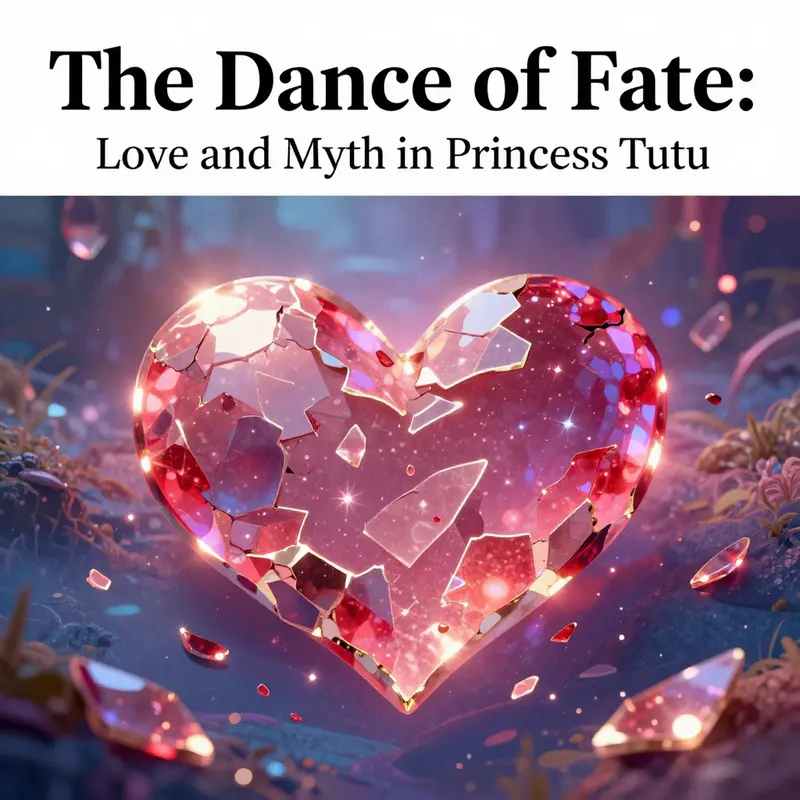
The heart shards in Princess Tutu are a language rather than a plot device. They speak in light and shadow, in the space between memory and feeling, guiding Mytho toward a more capacious sense of self. Mytho begins as a prince of a legend whose heart was fractured by betrayal. The four shards, scattered through dreamlike landscapes and reflective rooms, map a journey from distance to tenderness.
Each fragment carries a vocabulary of emotion—memory, vulnerability, love, and accountability—and each return reconstitutes not only his heart but his capacity to feel for others. The shards insist that healing is not about restoring a pristine past but about reweaving a life in which memory and longing can coexist with responsibility. The show stages Mytho’s gradual awakening with a quiet vocabulary of gesture and gaze rather than grand triumph, privileging ethical risk over dramatic conquest.
Ahiru as Princess Tutu embodies the paradox at the heart of the tale: desire and duty, longing and truth. The shards force Mytho to question whether a love that preserves a flawless idyllic world is worth choosing when that choice might require vulnerability or loss. The result is a meditation on care and consent, on the idea that a myth can endure only if its tellers allow imperfection to reshape its meaning.
Visually, the shards glow with pale luminosity, their surfaces delicate yet inexorable. Their material presence anchors a larger argument that identity is a dynamic practice of memory, empathy, and choosing to stay with another even when the path is unwritten. In that sense, the heart shards become a pedagogy of healing, a reminder that becoming human again often requires the patient work of listening, forgiving, and reimagining a future together.
Final thoughts
The intertwining destinies of Princess Tutu and Mytho create a captivating narrative that explores love, self-discovery, and the rich symbolism inherent in their journey. As business owners and creators, we can draw valuable insights from their story, understanding the importance of compassion, connection, and the struggles we face in pursuing our aspirations. Just as Princess Tutu navigates the intricacies of her fate to support Mytho, embracing collaboration and empathy can redefine our paths in the business world, guiding us toward fulfilling our potential.