
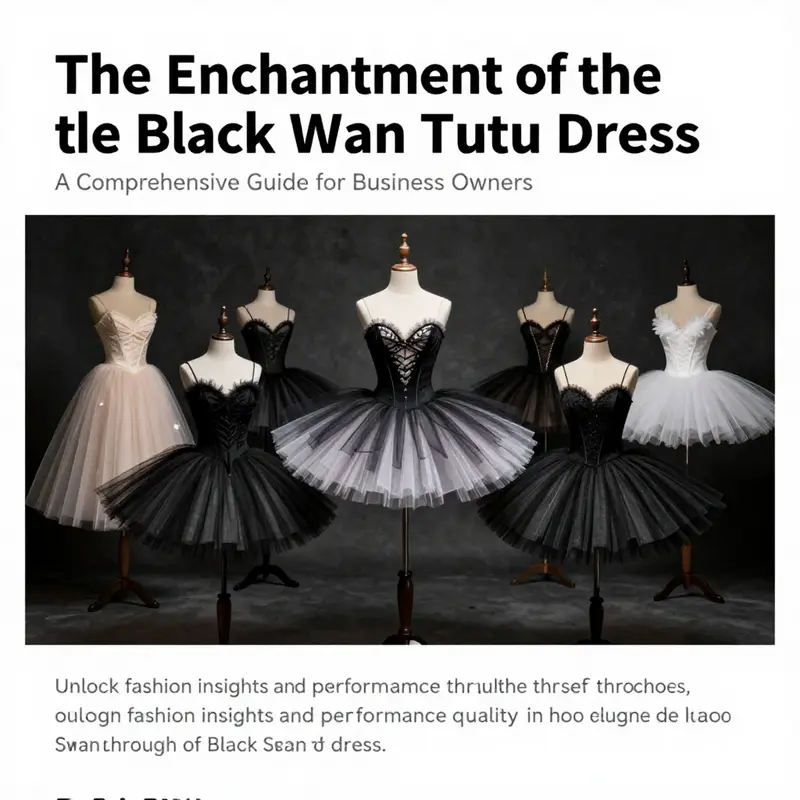
The Black Swan tutu dress, inspired by the iconic ballet Swan Lake, symbolizes both elegance and mystery, representing the duality of the black and white swans. As it has permeated both ballet performance and contemporary fashion, understanding this garment is crucial for business owners involved in dancewear, costuming, and high fashion. Each chapter of this guide is dedicated to dissecting important aspects tied to the Black Swan tutu dress—from its integral role in ballet performances to its influence in fashion and finally, practical purchasing advice for retailers and costume designers alike. Recognizing the dimensions of this dress not only serves to inspire the market but also allows businesses to cater to the evolving preferences of consumers.
Velvet Echoes and Shadowed Grace: The Black Swan Tutu Dress on the Ballet Stage

The Black Swan tutu dress stands at a compelling crossroads where literature, choreography, and couture converge. It is not merely a costume but a living frame for a narrative that unfolds in motion. In the most storied ballet of the classical repertoire, Swan Lake, the Black Swan figure embodies a dangerous glamour and a secret vigor that pull the audience toward the edge of transformation. The robe of darkness that envelops Odile is not only a color choice; it is a manifesto about power, seduction, and the perilous allure of a choice that can redefine a dancer’s arc in a single spin. When the curtain rises on Odile’s entrances, the audience reads more than a costume. They read the tension between two kingdoms of self—the pristine, crystalline poise of Odette and the shadowed, searing intensity of Odile. The Black Swan tutu dress, in this sense, becomes a visual shorthand for that duality, a garment that seems to harness both the stillness of a poised arabesque and the wild energy of a late-cocked jeté. This is where design, technique, and storytelling meet on stage and in the mirrors backstage, where a dancer learns to inhabit a silhouette that feels at once ancestral and urgently contemporary.
Historically, the Black Swan is less a mere color choice than a narrative instrument. Odile’s costume is meant to convey transformation—the moment when a character’s inner strategy cracks through the surface of a performance. The garment is designed to be bold, almost audacious, and yet controlled enough to allow the body to execute the precision of a grand jeté or an intricate port de bras with unwavering clarity. The costume’s silhouette often reads as a deliberate contrast to the White Swan’s luminous, airy lines. The black velvet bodice anchors the ensemble in velvet’s tactile luxury, while the skirt—built from stiffened layers of tulle—extends the dancer’s presence into a storm of movement that looks both sculptural and alive. It is a trick of optics as much as a feat of engineering: the tutu’s stiffness grants a constant, legible arc to the leg line, even as the dancer passes through rapid hyperextensions and aerial spins. In this sense, the Black Swan tutu is not simply attire; it is a stage partner, a collaborator that amplifies the choreography’s intent and amplifies the dancer’s authority on the floor.
The design is rarely static. Its most iconic expression sits at the threshold between white feathery suggestion and black velvet gravity, a transition that visually encodes the odyssey of Odette’s counterpart. Designers have embraced asymmetry and jagged edges to evoke a sense of organic, predatory elegance. Feathers, or feather-like textures, are positioned to shimmer subtly under the glare of stage lighting, catching the eye as the dancer moves through spins and pivots. The edges are intentionally irregular, imitating the suggestion of a bird’s wing in flight yet tethered to a couture structure that keeps the costume from losing its disciplined silhouette. This is not a reckless flourish but a calculated choice that ensures the dancer’s lines remain legible while the narrative tension intensifies. When the dancer shifts from a poised pose to a rapid sequence of turns, the tutu must sustain its shape while letting the body breathe and respond to every cue. The visual impact—sudden, striking, and unforgettable—depends on the delicate balance between volume, stiffness, and mobility.
Behind the velvet and tulle lies a modern sports-lace logic that enables the dancer to perform with technique rather than against it. Contemporary professional tutus fuse traditional craft with advanced textile science to withstand the rigors of demanding choreography. The fabrics selected prioritize flexibility, resilience, and shape retention. A blend of elastic fibers together with synthetic textiles provides the necessary stretch to accommodate the changes in alignment that come with complex port de bras and multiple spins. Breathability remains essential; even during the most dramatic solos under hot stage lights, the wearer must remain comfortable enough to execute turns with precision. Moisture-wicking linings and breathable interiors reduce heat buildup and help the dancer maintain concentration through long rehearsals and extended performances. These fabric choices also influence maintenance: the ability to retain color, resist creasing, and endure repeated high-energy routines becomes as important as the beauty of the color itself. In essence, the material science behind the Black Swan tutu dress is quiet but decisive, shaping performance rather than merely decorating it.
The tutu’s architecture offers a masterclass in stage geometry. A typical Black Swan design blends a structured bodice with a voluminous, multi-layered skirt. The bodice—often a deep, opaque black—anchors the silhouette and provides a secure base for the arms, shoulders, and torso to move with confidence. The wearer’s posture benefits from tailored seams and ergonomic shaping that encourage an elongated spine and elevated chest, which in turn supports a longer, more expressive port de bras. The skirt, constructed from stiffened tulle, holds a dramatic horizontal plane that creates a halo of movement around the dancer’s legs. This architectural stance makes each leg extension visible to the audience even when the dancer is at height or in the midst of a fast turn. When light strikes the surface, the matte velvet of the bodice absorbs and re-emits a controlled glow, while the tulle catches glints of the stage, creating a subtle, shifting radiance that enhances the illusion of flight and power.
The relationship between fabric and cut is not merely about aesthetics; it informs technique. A 12-layer approach to the skirt’s construction, for example, is designed to deliver a symphonic fullness without sacrificing the dancer’s mobility. Each tier contributes to the overall silhouette, creating a cardiac rhythm of volume that breathes with every step, leap, and twist. The result is a garment that keeps its shape through the most demanding sequences while still allowing the dancer to engage deeply with the choreographic language. The stiffened tulle behaves like a measured instrument, resisting droop and collapse mid-performance. It remains faithful to the choreographic demands, ensuring the impressive line that audiences expect from Odile’s most iconic entrances. The interplay of stiffened fabric and pliant bodice translates into a performance language where grace and intensity advance together, never at odds.
This balance between stiffness and suppleness carries through to ergonomic design choices. Deep V-necklines, sculpted straps, and a form-fitting bodice are not merely stylistic preferences; they are essential for freedom of movement during the most demanding sequences. The practical demand is clear: a dancer must be able to execute a precise port de bras, a rapid series of pirouettes, and a clean finale without the costume encumbering the torso or obstructing the line of the arms. The right neckline and strap geometry reduce shimming and shifting, ensuring a consistent fit as the body heats up and cools down during a performance. The color palette—an almost tantric interplay of matte black with occasional lustrous highlights—helps the dancer read the silhouette against the stage lights, guiding the audience’s eye along the leg lines, the arc of the arms, and the extension of the neck. Such design decisions are inseparable from the choreography’s demands, because a costume that fights the dancer undermines every attempt at clarity and expressiveness on stage.
Beyond the physical mechanics lies a deeper dramaturgical function. The Black Swan tutu dress is a visual embodiment of transformation and deception. The choice to bind a creature of mystery to a garment that is both regal and dangerous mirrors Odile’s role: a catalyst who triggers shift, intrigue, and the possibility of downfall. The costume thus serves as a conduit through which the dancer can communicate the odyssey from confidence to cunning, from vulnerability to control. The garment’s weight and distribution can alter the tempo of a sequence, subtly coaxing the dancer into a more forceful or more measured cadence. In practice, a performer may use the tutu’s mass to accentuate a particular beat or to punctuate a dramatic pause, letting the fabric perform some of the narrative work with the dancer as its thoughtful conductor. This synergy—the dancer guiding fabric, and fabric amplifying intention—defines the Black Swan’s most memorable stage presence.
In contemporary productions, designers often adapt the Black Swan idea to broaden its expressive range. The concept travels easily into fashion-forward interpretations, where designers blend classic silhouettes with avant-garde textures and silhouettes. The transformation motif remains central, even when the garment becomes less about literal black-and-white symbolism and more about a broader sense of metamorphosis and reinvention. Costumers and designers may experiment with variations in the bodice height, sleeve choices, or skirt stiffness to suit different performers or to align with a particular directorial vision. The goal remains constant: maintain the architecture that preserves the dancer’s mobility while allowing the aesthetic to read as a formidable, transformative force on stage. This adaptability is what keeps the Black Swan tutu dress a living tradition rather than a static emblem of a single production.
The garment also inhabits a broader cultural dialogue about performance, beauty, and power. In fashion conversations, the Black Swan idea has extended into eveningwear and couture-inspired ensembles, where designers borrow its duality to craft statements about mystery and resilience. The black swan aesthetic, when refracted through the lens of formal wear, becomes a meditation on transience and control—the moment at which elegance becomes an instrument for self-authorship under the gaze of an audience. The same energy informs the stage practice: the tutu is a vehicle for storytelling that can carry an entire act with a few decisive cues, a handful of spins, and a voice that is as much about the line of the body as the music that accompanies it. For those who study or practice ballet, the Black Swan tutu dress offers a compact case study in how a single costume can fuse narrative payload with technical prowess.
For practitioners, the importance of safety, comfort, and adaptability cannot be overstated. Modern professional tutu construction frequently incorporates standards that emphasize safe materials and durable construction. OEKO-TEX certified fabrics, for example, provide assurance that the materials have met rigorous safety criteria, a factor especially important for young performers who will wear the costume through long studio sessions and staged performances. Adjustable sizing options allow the same garment to accommodate a range of body types, ensuring a secure fit that does not impede movement. The capacity to fine-tune shoulders, straps, and bodice compression allows choreographers and costume supervisors to match the garment to each dancer’s unique shape. This kind of customization is critical in professional settings, where even minor adjustments can improve turnout, line, and the dancer’s ability to hold a challenging position under bright lights and the pressure of a live audience. The result is not merely a garment that looks the part but a practical instrument that supports the dancer’s artistry and the director’s vision.
In the end, the Black Swan tutu dress is most powerful when it is understood as an instrument of storytelling as much as a piece of attire. Its power emerges from the quiet authority of its silhouette, the tension between shadow and light that the color palette invites, and the engineered resilience that allows a dancer to move with both economy and grandeur. It is a garment that asks the performer to own an inner paradox—the pull of mystery and the discipline of technique—so that the audience can witness a transformation that is as much internal as it is visible. When Odile appears in a line of dancers who have trained to synchronize breath with motion, the Black Swan color and form become a language, speaking in the rhythm of plié, relevé, and a final, decisive pâté. The audience reads not only the external drama of a villainous figure but the internal drama of a dancer who has learned to carry both light and shadow with equal grace.
For a sense of how this concept translates into a Swan Lake-inspired collection, explore the Swan Lake Swan Lake category. The continuity between stage costume and design-led reproduction helps illuminate the broader appeal of the Black Swan tutu dress across performances and reinterpretations. To widen the scope of visual references and inspiration for this iconic silhouette, artists and designers turn to a vast gallery of ballet outfits, where the Black Swan’s essence often appears in fields well beyond the proscenium. In practice, the garment’s impact is measured not only by its ability to capture attention during a single act but by how it continues to inform and resonate through subsequent seasons, productions, and collaborative design conversations.
As this exploration circles back to the dance floor, it becomes clear that the Black Swan tutu dress is a study in a delicate balance: of tradition and invention, of discipline and drama, of fabric’s architecture and the dancer’s breath. It invites performers to inhabit a character who is both certain and unknowable, and it invites audiences to experience the immediacy of live movement—the moment when velvet and tulle become more than material, when they become an extension of intention and an intensified amplifier for story. In that sense, the Black Swan tutu dress remains one of the most potent embodiments of ballet’s capacity to render emotion in fabric, to crystallize transformation in a silhouette, and to remind us that the stage is where form becomes meaning, and meaning, in turn, gives form to the moment we call performance.
External resource for further inspiration: Ballet Outfit Performance Ideas.
Between Darkness and Ethereal Light: The Black Swan Tutu Dress and the Balletcore Revolution

From the moment the screen blooms with Nina’s shifting silhouette, the Black Swan tutu dress enters a conversation not only about clothes but about identity itself. It is a garment that speaks in contrasts: darkness and light, discipline and craving, perfection and ruin. Its visual drama is not a mere flourish of stagecraft; it is a narrative device that translates inner weather into fabric and form. The dress becomes a map of Nina’s psyche, a tactile ledger where the viewer reads her movements as clues to her evolving self. This is why the Black Swan tutu dress continues to resonate far beyond the proscenium. It has moved from the confines of the theater to the broader imagination of fashion, shaping how people think about wardrobe as a medium for mood, transformation, and storytelling. The result is a balletcore sensibility that asks not just what we wear, but how our clothes rehearse who we are on any given day.
The dual symbolism at the heart of the Black Swan look begins with the color and the silhouette. Black conjures mystery, power, and danger, while the white swan that accompanied Odette in the classic ballet evokes purity, light, and grace. In the cinematic version that popularized the look, the contrast was sharpened into a visual dialect: the same wearer can glide between vulnerability and intensity, between restraint and unleashed energy. The tutu—a stiff, fanned assemblage of tulle—amplifies this dialect. Its rigidity holds the form in a way that mirrors discipline, yet the volume creates a sense of breath and movement that betrays the tension beneath control. The contrast is not accidental; it is a design choice calibrated to translate abstract themes into a physical experience. In a wardrobe, this translates into pieces that carry a performance-weighted presence—elegant at first glance, with an undercurrent of potential drama that reveals itself with the simplest shift of a hip or a turn of the torso.
In overarching terms, the Black Swan tutu dress sits at the intersection of costume craft and fashion experiment. The bodice is typically crafted in a dark, sumptuous fabric—often velvet or a similarly rich textile—that catches light with a quiet, velvet-brilliant sheen. The neckline, frequently designed to create a nude illusion, elongates the torso and directs the eye toward the dancer’s or wearer’s posture. The real signature, however, is the skirt. A cascade of stiffened tulle, layered to achieve maximum volume and a sculptural, almost architectural silhouette, creates a counterpoint to the soft curve of the bodice. This is not a mere tutu but a statement about how structure can harness motion. Even outside the theater, the effect remains—an emblem of gravity-made-glamour that can be read as a metaphor for control under pressure. It is precisely this capacity to fuse rigidity with buoyancy that keeps the look relevant in modern fashion conversations.
The substance of the look is matched by its symbolism. The black tutu is not just about seduction or peril; it is about the negotiation of self in spaces that demand performance. The wearer must project certainty, even as the mind may churn with doubt. In design terms, that tension is captured in the way the silhouette plays with line and light. The black bodice anchors the figure, while the skirt breaks the horizon into a cloud of motion. The effect can be intensified by a nude V-neck or a strategic illusion panel that lengthens the torso, suggesting a continuum between the earthly and the ethereal. Designers exploring this concept often emphasize the drama of a single pose—arms poised, torso aloft, gaze controlled—so that the fabric, in its fullness, does the talking. The garment thus becomes a partner in performance, a co-creator of the moment when intention becomes visible through posture and shape.
This is where the dress transcends its cinematic origins and becomes a touchstone for contemporary styling. The look’s influence has extended into fashionable iterations that borrow its core lexicon—darkness as luxury, structure as statement, and contrast as theme. The resulting aesthetic has been described in fashion discourse as balletcore—a term that captures how classical ballet codes, sensual silhouettes, and modern tailoring converge in everyday wardrobes. Balletcore is not about literal costume replication; it is about translating a mood into wearable form. Some interpretations lean toward sleek, tailored pieces that echo the discipline of the stage; others embrace the textural drama of velvet, tulle, and metallic finishes to evoke the same emotional cadence. The bottom line is a shift in how people approach elegance: a preference for pieces that feel both curated and alive, capable of shifting their energy with movement and light.
In embracing the Black Swan look, designers often play with texture and finish to heighten the impact without sacrificing wearability. Velvet’s depth provides a quiet, almost velvet-black mirror that can absorb light and reflect it back with a softened, afterglow. Tulle, in multiple layers, offers a sculptural airiness that suggests motion even when the body is at rest. The layering is deliberate; it creates a density that reads as fullness on stage and as volume on the street. When metallic accents or satin piping appear, they act as highlights that trace the garment’s architecture, drawing attention to the waistline, the curve of the hip, and the line of the leg. The result is a look that can be as formal as a red-carpet moment or as intimate as a costume-inspired party, but always with a sense of performance built into the fabric. The choreography, so to speak, happens in the way a wearer negotiates the garment’s bulk and the room’s space, how they hold themselves, and how the outfit carries their momentum from one moment to the next.
The look’s cultural footprint extends beyond runways and editorial shoots. It has invited a spectrum of stylists and wearers to explore balance—between drama and restraint, between dark romance and practical wear. The Black Swan tutu dress encourages a curated devotion to silhouette—an embrace of a strong, sculpted line that can stand against more delicate elements of an outfit. Accessories—ears, jewelry, and subtle embellishments—have become important as finishing touches that can tip a look from theatrical to chic, from statement to refined. The move toward minimalist accessories is common, allowing the garment’s own narrative to carry the scene. When jewelry is chosen, it tends to reflect the same duality: forms that feel essential and clean, with designs that offer a sense of orbit around the face rather than competing with the gown’s volume. The careful selection of footwear becomes equally decisive. A glove of satin or a pointed heel with a hint of gleam can echo the tutu’s sheen while still delivering modern practicality for events that require hours of wear.
The interplay between stagecraft and streetwear is not accidental. It reflects a larger cultural appetite for garments that tell a story with restraint and force: pieces that are not simply worn, but performed. The Black Swan motif invites people to consider clothing as a vehicle for mood, not merely appearance. This shift aligns with broader fashion conversations about identity, agency, and narrative in clothing. When a dress can evoke a narrative bend—moments of doubt giving way to power, fragility giving way to command—it gains a resonance that goes beyond aesthetics. In this sense, the look becomes a language. It speaks of time, of art, and of personal risk taken in the name of self-expression. The result is a style that feels both timeless and contemporary, a garment that settles quietly into the wardrobe while still offering the thrill of a dramatic revelation when the wearer moves.
For those who seek authentic performance-oriented pieces, the design philosophy remains rooted in mobility and durability. A well-made Black Swan tutu dress is crafted to support dynamic movement: the bodice is tailored to provide a secure fit and to maintain posture during rapid turns and leaps, while the skirt’s stiffened layers hold their shape through extensive motion. A nude illusion V-neck is crafted with care to avoid pinching or discomfort while enhancing the illusion of a continuous line from neck to waist. Sizing across both children and adults has to reflect the demands of a stage environment, with thoughtful considerations for range of motion, breathability, and the stress points where seams endure repeated flex and stretch. The aim is to create a garment that feels almost like a second skin during performance, yet remains comfortable and durable enough for rehearsals and longer wear. In theatrical contexts, such pieces are paired with appropriate understructure and supportive accessories to ensure the silhouette remains crisp, even under lighting and heat from stage lamps. Outside the theater, these principles translate into wardrobe options for themed events or personal exhibitions of theatricality, where the wearer seeks to project a disciplined, cinematic aura without compromising everyday wearability.
In fashion discourse, the Black Swan look has proven to be a versatile anchor for stylistic experimentation. Designers often reinterpret the central tenets—rich, dark textures; a commanding silhouette; and a dramatic sense of scale—by layering in unexpected elements. A touch of metallic sheen can read as a whisper of drama in evening wear, while a more restrained approach can yield a gown that feels almost ceremonial. The key is to preserve the emotional charge of the original concept while allowing the wearer to inhabit it in different contexts. This is how the look migrates from a highly specific cinematic moment to a broader sartorial vocabulary: as a reference point that informs new silhouettes, materials, and finishes. The look’s narrative power persists because it is not merely about beauty; it is about perception, intention, and the capacity of clothing to alter how a person carries themselves and how others read them in social and cultural spaces.
For enthusiasts who want to explore this aesthetic further, the Swan Lake-inspired category offers a curated range of pieces that echo the duality at the heart of the look. These variations invite wearers to experience the same sense of transformation in different scales and contexts. The category serves as a quiet invitation to study how a single silhouette can bend toward both solemnity and spectacle, depending on how it is styled, lit, and moved in. By examining these options, one can see how the old world romance of classical ballet merges with contemporary design instincts, creating a wardrobe language that can be both intimate and grand. For those curious about how this motif can translate into a modern closet, browsing the collection offers a practical sense of how the drama translates to real life, from social events to intimate moments of personal expression. Swan Lake product category provides a useful touchstone for understanding the range of forms, textures, and silhouettes that honor the source while inviting new interpretations.
In essence, the Black Swan tutu dress endures because it captures a universal tension—the desire to be seen and to remain unseen at once. It is a garment that asks its wearer to balance discipline with impulse, to choreograph stillness and motion, to inhabit a mood that feels both ancient and urgent. It is a fashion statement, yes, but also a compact narrative about how we present ourselves to the world when the lights go up and the room holds its breath. This is the power of the look: it makes the wearer a co-creator of a moment that feels larger than life, even as it remains intimately human. In a culture increasingly attentive to how clothing shapes perception, the Black Swan tutu dress offers a vivid case study in how fashion can translate myth into wearable memory, how a single garment can carry the memory of a film, a performance, and a cultural mood across seasons and audiences.
External resource: https://www.vogue.com/article/black-swan-balletcore-trend
Choosing the Black Swan Tutu Dress: A Performance-Ready Guide to Style, Fit, and Durability

The Black Swan tutu dress sits at a crossroads where mythic storytelling meets the disciplined craft of ballet costume making. It carries a dual symbol: the shadow of Odette or Odile and the memory of a white swan gliding under stage lights. To wear this dress is to enter a tradition that values silhouette, structure, and stamina as much as drama and mood. A practical buying guide must move beyond aesthetics toward a holistic understanding of what makes a Black Swan tutu dress not just beautiful, but performance-ready, durable, and comfortable for long rehearsals and nights on stage. This is about choosing a garment that collaborates with the dancer, supports choreography, and speaks to the audience through controlled movement and quiet presence. The path to that choice begins with a clear sense of purpose: will the dress be worn in a professional production, a school recital, a community theatre event, or a fashion-oriented interpretation that nods to ballet while bending its rules? Each context invites a slightly different emphasis, yet the core criteria remain consistent: fabric quality, design authenticity, sizing, finishing, and care. When these elements align, the Black Swan tutu dress becomes a partner in performance, capable of withstanding the rigors of dance, lighting, and show tempo.
Fabric quality forms the quiet backbone of any tutu dress. The decision between cotton and chiffon signals how the garment will behave under hot lights and repeated rehearsals. Cotton offers durability, resists wrinkles, holds bodice shape, and provides a sturdy base for a structured silhouette. Chiffon adds softness and drift to the skirt, catching light to evoke swan imagery. A best practice often blends both: a sturdy bodice in cotton or satin with multiple layers of stiffened tulle or chiffon for volume. This combo yields the classic silhouette: a velvet or satin bodice anchoring the look, with a skirt kept upright by internal stiffness.
Design authenticity sits next to fabric in determining how close a dress stays to the Black Swan aesthetic. The iconic look uses a sleek leotard beneath a layered tutu skirt with a disciplined silhouette that allows mobility. The bodice is typically structured and finished in black velvet or similar rich fabric. A nude neckline line may appear in some designs to elongate the neck. The tutu skirt tends to be layered and semi-asymmetric, with stiffness to hold the shape during spins and leaps. For productions referencing the white swan memory, balance between dark bodice and lighter skirt can guide the overall mood. The goal is to preserve ballet standards while allowing for modern durability, including stronger fastenings, reinforced seams, and a range of sizes to fit different dancers.
Size and variety enter the conversation as practical realities. Rehearsal spaces and performance schedules rarely align with one-size-fits-all, so a broad size range is essential. Wholesale options can offer cost-effective solutions for ensembles that need many pieces. The tradeoff is that the selection may emphasize standard sizes and easier care over boutique customization. When buying in bulk, verify fabric composition, tutu layers, bodice lining, and fastening system for security during moves. For individuals, retail options usually offer more sizes, more design nuance, and clearer return policies but at higher prices. In practice, this means weighing flexibility against ownership costs. A well-made Black Swan tutu dress should accommodate growth over a season or adapt to different silhouettes. It should offer practical care features such as care labels that advise hand washing or delicate machine washing. Clear care guidance and durable stitching help the garment survive frequent laundering and transport.
Shopping strategy becomes a balance of cost, quality, and use. For a studio outfitting many dancers, consistency across pieces is key: same cut, same length, the same stiffness in the tutu, and uniform bodice fit. Wholesale options can be good if the supplier provides thorough product descriptions and batch-to-batch consistency. Request swatches or inspect a sample for bodice lining, neckline elasticity, and skirt layer rigidity. For a single performance or fashion-forward interpretation, retail purchases can offer broader aesthetics, refined finishes, and the chance to choose a silhouette that aligns with a director’s or designer’s signature look. In any case, measure fit for dynamic movement, verify fabric and construction durability, and ensure the garment delivers the necessary visual impact while honoring the Black Swan mood.
Buyer’s process: Start with a performance profile including roles, dancer count, and stage conditions. Map needs to fabric and construction criteria: bodice stiffness, skirt volume, movement ease, color stability under lighting. Evaluate options by technical specs: reinforced seams, durable waistband, and secure layer attachment. Consider care instructions and fabric quality as top considerations. Include return policy, delivery timelines, and after-sales support. A reliable supplier provides size charts, measurement guidance, and readiness for alterations or customization. A well-chosen costume can reduce time spent adjusting costumes and allow dancers to focus on precision and artistry.
To close, consider the Black Swan motif in costume design: contrast between dark, velvety surfaces and the dancer’s rigid, geometric tutu. The costume becomes a partner in storytelling, guiding lines, supporting extensions, and framing the ensemble to elevate turns and leaps. Imagine how it feels in real time: when backstage light catches the bodice and reveals a sculptural glow, or when the stiff skirt holds its shape after a grand jeté. The stakes are reliability under pressure, consistency through a run of performances, and ensuring the costume helps tell a story rather than distract with misaligned seams. For deeper guidance, explore Swan Lake costume resources to observe how designers balance tradition with modern technique. This can illuminate how to translate a motif into fabric choices, silhouette decisions, and finish details, offering ideas for what to seek or avoid in a Black Swan look. The best outcomes arise when your buying decision is informed by design intent and practical testing—examining fabric breathability, lining feel, and how the tutu behaves in movement.
Finally, the end: The journey is about balancing elegance with performance demands, cost versus customization, and care as a life cycle component. As productions evolve and designers reinterpret the Swan Lake myth for new audiences, the right Black Swan tutu dress remains a faithful ally to ballet craft and storytelling. It becomes a living component of the shared artistic experience, ready to move with the dancer and to carry the audience through transformation and revelation that define the Black Swan legend.
External resource for deeper guidance on tutus and costume construction: https://www.balletcostumeswholesale.com/guide-to-tutus/
Final thoughts
The Black Swan tutu dress is more than just a costume; it represents a powerful convergence of performance art and fashion design. By appreciating its significance in ballet and its broader influence in the fashion sphere, business owners can better navigate this sector, whether they are designing, manufacturing, or retailing these iconic dresses. As the demand for both authentic performance pieces and high-fashion interpretations continues to rise, engaging with this narrative will empower brands to capture the essence of the Black Swan, resonate with their audience, and thrive in an evolving market.