
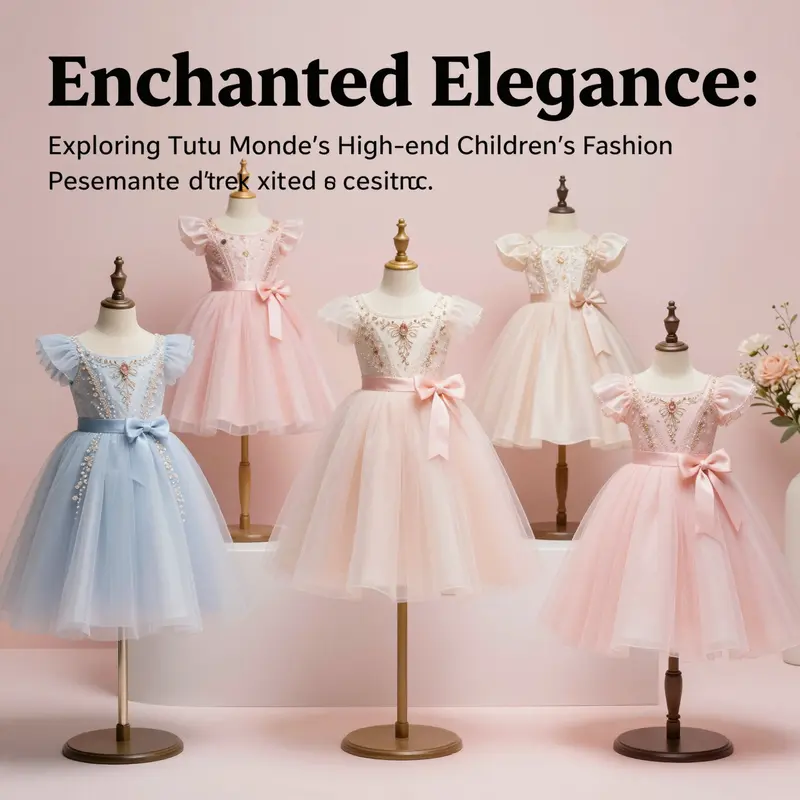
TUTU DU MONDE stands as a paragon of high-end children’s fashion, captivating the hearts of parents and children alike with its exquisite designs and enchanting aesthetic. Rooted in a blend of dreamlike luxury and careful craftsmanship, the brand creates garments that not only elevate a child’s wardrobe but also promote positive emotional values. This article unravels the unique world of Tutu Monde through four key chapters. We will explore its dreamlike essence, the meticulous craftsmanship behind its designs, the brand’s powerful impact on children’s identity through emotional values, and finally, its growing global influence in the children’s fashion sector.
Dreams Woven in Tulle: The Global Illumination of Tutu Monde’s Little Worlds

In the quiet hush between a ballroom echo and a child’s first bow, a dreamlike world takes shape. Tutu Monde—often spoken of as a beacon at the intersection of luxury and childhood imagination—operates not merely as a label but as a philosophy. Its garments do more than cover small bodies; they cradle the moment when a girl learns to stand tall enough to let a story come alive. The collection reads like a fairy tale written in fabric: layers of delicate lace, cascades of soft tulle, gentle bows, and glimmering sequins that catch light the way constellations catch the eye. The aesthetic is unmistakably couture, yet it is anchored in a practical truth: clothing for children must move with them, not against them. Balance becomes the core of the craft. Designers seek to fuse the headier temptations of high fashion with the everyday realities of a child at play, ensuring that elegance never sacrifices comfort or freedom of movement. In this light, the brand’s dreamlike vocabulary—voluminous skirts that float, embroidery that whispers rather than shouts, and a palette that reads like a storybook—functions as a language. It speaks of princesses who stroll down city sidewalks as easily as they glide down a ballroom. It speaks of mothers who want to honor moments that feel timeless, from flower girl duties to the first formal family celebration, with garments that feel both ceremonial and alive.
What makes this world feel so distinct is not only the surface beauty but the underlying impulse. The design ethos is less about chasing trends and more about nurturing a sense of wonder that can accompany a child through years of growth. The promise is not merely to dress a moment but to illuminate it. The pieces become a seal on memory, a tangible artifact of the way a girl learns to turn ordinary occasions into something radiant and collectible in the heart. This perspective aligns with a broader, almost maternal ambition: to listen to a child’s joys with care and to nurture her innocence with love. In practice, that translates into gowns that are generous in silhouette yet precise in detail, allowing a young wearer to embody a character she imagines while still feeling safe and unconfined. The result is a wardrobe that doubles as a rehearsal space for confidence, where the mirror reflects not a finished product but a budding sense of possibility.
Central to the brand’s narrative is a tactile language of materials. The tactile vocabulary—lace, tulle, chiffon, and subtle sequins—does more than flatter. Each component is chosen for its ability to tell a story without shouting. Lace threads whisper of vintage romance; tulle layers float with a buoyant grace; chiffon drapes softly around tiny frames in a way that suggests movement rather than constraint. Hand embroidery often acts as a quiet punctuation mark, a personal touch that hints at the care poured into every piece. These choices reveal a respect for craft that elevates childhood wear into an experience that feels almost ceremonial. Yet the most enduring quality is not the sheer force of luxury but the intention behind it: to create an atmosphere in which a child can move with poise, feel cherished, and discover the joy that comes from looking and feeling your best during moments that become stories later told at family gatherings or shared in photographs that linger decades hence.
The international reach of this dream is a testament to how fashion, even when scaled down to children, can become a shared language across cultures. Aesthetic reference points drift in and out of view, but the current remains consistent: an invitation to imagine. The brand’s presence on the world stage—whether at fashion weeks or in the pages of glossy spreads—signals that luxury for children can be more than a status symbol. It can be a cultural practice, a daily reminder that beauty can be light, ethical, and deeply human. This is not about adult-sized glamour translated down; it is about translating a grown-up aspiration into a form that respects the pace and laughter of childhood. When little girls walk in these gowns, their steps too become a choreography, a microcosm of the larger dance of life—where elegance is not about perfection but about presence, about the glow that comes from feeling seen.
In the evolving dialogue between fantasy and function, the brand makes a quiet but audible claim: the dream itself matters. The garments are designed as instruments of narrative, enabling a child to inhabit a role with a sense of agency rather than merely to perform for adults. A wedding flower girl dress, for example, is not treated as a costume but as a rite of passage—a moment when a girl steps into a larger stage with tenderness and dignity. The design team understands that such moments are as much about emotional resonance as about a striking silhouette. The emotional dimension is explicit in the brand’s stated mission to illuminate innocence with love while listening to joys with care. It is a gentle reminder that fashion, at its most luminous, can be a form of emotional pedagogy. Through carefully chosen fabrics and careful construction, the clothes model a posture of grace and curiosity—two traits that empower a child to handle attention with ease and to navigate growth with a light, buoyant confidence.
The conversation about origin, time, and place naturally threads into this broader tapestry. The Australian milieu—where designers often blend a coastal buoyancy with a refined, Parisian-inspired elegance—shapes the brand’s character. The narrative is sometimes anchored in the idea of an inspired parent or designer seeking the perfect ballet dress for a daughter, a seed that grew into a broader, globally beloved line. Yet the sources vary in naming the founder and the precise year, a reminder that the story of a fashion house can be as much a folk memory as a documented chronicle. What remains unaltered across these accounts is the core idea: a label born out of a desire to make girls shine at moments that matter, to let them inhabit a world where dreams are woven into every seam, and to transmit a philosophy of care—care for the child who wears the dress and care for the world she will grow into. The result is a collection that feels as if it has always existed in the space between a daydream and a runway, between a mother’s whisper of encouragement and a daughter’s first public entrance.
This mood of storytelling through garment, rather than mere dressing, aligns with a broader movement in luxury fashion for children. The idea that clothes may offer “wearable art” resonates with families seeking a refined sensibility that does not demote play to a lesser costume. The brand’s appeal rests on the harmony of two seemingly opposed impulses: ceremony and movement. A gown may carry a complex embroidery that reads like a small work of art; the wearer, in turn, is free to run, spin, and choreograph a game of pretend with the ease of a child who has not yet learned to fear falling. This synthesis—where beauty and practicality walk hand in hand—makes the collection a magnet for families who demand quality without compromising the spirit of childhood. The result is a global footprint that includes red-carpet moments and intimate family celebrations alike, with the same promise threading through every piece: that a girl can dream in colors, textures, and shapes that feel like poetry expressed in fabric.
An essential bridge in this narrative is how the brand translates the intimate, maternal language of care into the world of retail and distribution. The shopping experience—whether in boutique settings, at high-end retailers, or through curated online platforms—must feel as carefully curated as the dresses themselves. The idea of a “world within a world” also manifests here, as luxury buyers are invited to step into a carefully balanced ecosystem where storytelling, craftsmanship, and emotional resonance converge. The brand’s global visibility—via events, celebrities, and editorial features—augments the perception that a dress is not merely a garment but a passport to participate in a shared dream of elegance that respects childhood innocence. For today’s families, the appeal lies not only in the visual spectacle of a gown but in the assurance that a purchase supports a philosophy—one that values care, imagination, and the gentle guidance of grown-ups who want to preserve the wonder that defines childhood while celebrating its milestones with beauty.
For those seeking to experience this dreamlike universe firsthand, modern luxury platforms offer access to curated collections that fuse tradition with contemporary flair. The curated approach mirrors the brand’s own meticulous attention to detail, inviting families to explore pieces that feel timeless yet fresh. In this sense, the journey resembles a pilgrimage through a gallery of textiles and silhouettes where every choice carries emotional weight. The experience, then, resembles a reverent unboxing, a small ceremony that helps a child transition from the realm of play to a moment of poised ceremony. And yet the garment remains an invitation to be yourself, to discover a personal mode of expression within the framework of refined formality. The clothes do not demand a character; they support the emergence of one, a subtle but powerful distinction that signals a deeper understanding of childhood aesthetics as something serious, yet not solemn.
To situate this dream within a broader cultural economy, it helps to look at how the global fashion ecosystem treats luxury children’s wear. The field has grown into a space where storytelling, craftsmanship, and responsibly sourced materials compete for attention, while social media and celebrity appearances broaden access to a mythical standard of elegance. The brand’s emphasis on emotional values—listening to joys, nurturing innocence, and enabling children to shine in every step—offers a refreshing counterpoint to fashion’s sometimes harsh emphasis on adult-level polish. It asserts that luxury can be soft, inclusive, and ultimately more enduring when it is anchored in affection and imagination. The idea that a small wardrobe choice can shape a child’s sense of self is not merely sentimental; it is a philosophy grounded in observation of how children respond to beauty. The garments become anchors in moments of growth, helping to crystallize self-confidence and resilience just as a child learns to articulate a preference for a color, a texture, or a silhouette. In this sense, the world these garments inhabit is less about a static standard of perfection and more about a living, evolving invitation to dream—with intention, care, and a sense of global belonging.
For readers who wish to peer more broadly into the luxury children’s wear landscape, a global platform that curates an array of dreamlike looks provides a useful frame of reference. Far from being a mere marketplace, such platforms offer a lens into how brands translate the fairy-tale vocabulary of childhood into a sustainable commercial language. They showcase the spectrum—from couture-level finesse to practical, movement-friendly designs—revealing how the dreamlike has become a staple of contemporary luxury fashion for the youngest wearers. This context deepens the understanding of why Tutu Monde’s world resonates so profoundly: it encodes a social longing for beauty that does not abandon the realities of childhood. It treats dress as a form of storytelling that supports emotional growth and collective memory, one gown at a time. The result is not merely a wardrobe but a constellation of possibilities that bloom whenever a little girl steps into a space that invites her to imagine, to perform, and to belong.
As one closes this exploration of the dreamlike universe that Tutu Monde embodies, the emphasis on light, texture, and narrative remains the guiding thread. The garments invite a child to inhabit a role with authenticity, not performance, and invite parents to witness that moment with reverence rather than detachment. The world that the brand builds around these pieces—a world where lace whispers, where tulle sways softly, and where every seam is a quiet vow to care—offers something timeless. It is an invitation to elevate the everyday rituals of childhood into chapters of a larger story, a narrative written in swirls of fabric and in the honest pride of a child’s smile. In this sense, the dreamlike world of Tutu Monde is less a trend and more a cultural practice: the belief that beauty can accompany growth, that imagination can guide taste, and that the most luminous fashion is not about dominating attention but about inviting it to pause, listen, and celebrate a child’s right to shine in her own world, wherever that world may be. The chapter of childhood beauty expands when such brands remind us that luxury can be humane, that style can be gentle, and that a girl’s dreams deserve to be dressed in something as extraordinary as the moments she will remember for a lifetime.
External resource: For a broader context of luxury children’s fashion on the global stage, see Farfetch’s curated Tutu du Monde collection: https://www.farfetch.com/shopping/kids/tutu-du-monde-2026-collection-clothing-1/
Internal link: The tangible bridge between fantasy and craft can be seen in pieces such as the high-quality-white-ballet-costume-tutu-swan-lake-t0596, which exemplifies how a single garment can merge performance-ready silhouette with wearable comfort. Discover it here: high-quality-white-ballet-costume-tutu-swan-lake-t0596
Where Dreams Weave Silk: The Design Philosophy Behind Tutu du Monde

In the world of Tutu du Monde, craftsmanship is a language spoken through fabric, thread, and light. It translates childhood dreams into garments that move with a child, not against her. This chapter examines how the brand blends couture precision with the ease of play, creating pieces that feel timeless yet alive. The core belief is that every girl deserves to shine, and every seam should support her imagination rather than constrain it.
Material choice sits at the heart of this philosophy. Boucle, chiffon, and tulle are selected not for surface sparkle alone but for how they behave in motion. Light plays across a seam, a hem flexes with a spin, and a lining breathes during a long day of play. Hand embroidery and delicate trims bring a human touch, reminding us that the garment is crafted with care by skilled hands.
The silhouette favors movement and airiness. Layers of soft fabric create a gentle bloom that swirls as a child runs, while an understructure preserves comfort and freedom. The result is a wardrobe that feels ceremonial yet ready for everyday adventures, a language of dress that invites stories and self expression.
null

null
From Australia to the World: The Global Reach and Influence of Tutu Du Monde in Children’s Clothing

In the quiet certainty of a girl’s dream, a single seam can stitch a world. Tutu Du Monde began in the crisp air of Australia, born from a mother’s wish to create the perfect ballet dress for her four-year-old daughter. The aim was simple in intention but expansive in imagination: to help every girl shine like a princess on moments that matter, while preserving the tenderness of childhood. The idea was not merely to clothe a child but to dress a memory—one that blends the elegance of a classical silhouette with the lightness of whimsy. In that balance lies the brand’s lifelong promise: to illuminate the moments when a child learns to stand on tiptoe and imagine galaxies in a twirl. Over time, this dream matured into a world-spanning aesthetic that feels both nostalgic and contemporary, a rare synthesis the fashion world often spends lifetimes attempting to perfect. The result is a language of lace, tulle, bows, and sequins that carries a distinctly French glow, a term used by connoisseurs to describe the brand’s ability to fuse heritage craft with a modern, international sensibility. Yet beneath the glamour lies a more intimate aspiration: to listen to joys with care and to nurture innocence with love, so that every garment becomes a small beacon of light in a child’s life, free to run, spin, and grow while being cherished.
To observe the global reach of Tutu Du Monde is to see how a local dream becomes a universal invitation. The brand’s signature layers of soft tulle and delicate lace translate across cultures, speaking a visual language that resonates with parents seeking something more than clothing—an experience. The design vocabulary—airy skirts, meticulous detailing, and whimsical accents—appeals to families who want their children to feel accented by fantasy yet never burdened by constraint. The aesthetic is a study in contrasts: retro elegance grounded in modern play, couture-level craftsmanship meeting everyday joy. This blend invites a cosmopolitan audience while preserving an unmistakable identity rooted in a love for childhood’s innocence. The global reception rests not only on beauty but on an emotional resonance: the sense that these gowns and dresses hold space for a child to act out a dream, to feel seen, and to express a personal narrative through form and movement.
The brand’s international ascent is visible in both its showings and its access points. Runway expressions at international fashion events have been celebrated for their cinematic quality—models move through flowing fabrics and layered tulle as if stepping into a fairy tale, with lighting and staging that heighten the sense of wonder. These moments matter not only for the spectacle but for how they shape perception: luxury in children’s fashion becomes less about scarcity and more about shared storytelling, about a world where every girl can imagine herself as the heroine of a private bedtime epic. The visual language travels with ease—from the simplicity of a well-cut bodice to the drama of cascading skirts—yet the emotional core remains constant: a belief in the beauty of childhood and the power of play as a form of learning. Such storytelling fosters a sense of belonging, inviting families from different continents to recognize in these garments a familiarizescape where a child’s imagination can roam unbounded.
The practical reality of global reach—distribution channels, online marketplaces, and curated retail partnerships—complements the brand’s dreamlike aesthetics. The rise of luxury platforms and white-glove shopping experiences has broadened access without diluting the brand’s core values. Online presence provides the means for parents and guardians across continents to discover, evaluate, and ultimately choose pieces that fit not only a size, but a moment in a child’s life: a first birthday, a family wedding, a school performance, a milestone that deserves ceremony. The tactile joy of fabric, the subtle glow of sequins catching a room’s light, and the careful engineering behind a dress that can be worn with ease by a lively child—all of these elements translate into trust when viewed through a screen and then realized in person. In a marketplace famous for quick turnover and mass branding, Tutu Du Monde claims a slower, more deliberate cadence: pieces that are cherished enough to become heirlooms, yet contemporary enough to remain relevant in a contemporary wardrobe.
What defines the brand’s global influence is not only the aesthetics but the emotional grammar it furnishes to families. The collection speaks about lightness and movement, about feeling free to explore the world while carrying a small sense of ceremony. The dresses invite a child to imagine, to perform, to rehearse a moment of grace, and to do so with a sense of self-worth that feels earned rather than borrowed. This emotional depth makes the garments more than objects; they become part of a family’s story—moments captured in photographs, cherished ceremonies, and the everyday magic of ordinary days that feel extraordinary when dressed with intention. It is this narrative power—this ability to translate a whispered dream into tangible, wearable joy—that explains why the brand has found receptive audiences far beyond its Australian home. Families in diverse climates and cultural contexts discover in the same architectural shapes and craft details something universal: the sense that childhood deserves a wardrobe of reverie and possibility.
The choreography of influence is less about chasing trends and more about nurturing identity. In this light, collaborations and cross-industry partnerships become opportunities to expand the dialogue rather than merely extend product lines. Imagined collaborations across fashion, lifestyle, and even education can be framed as playful experiments in storytelling that align with the brand’s core values. They reflect a broader cultural moment: a desire to preserve the enchantment of childhood while acknowledging its universality. The ethical backbone remains clear. The emphasis on careful listening to a child’s joys, on nurturing innocence with affection, translates into every decision from fabric choice to production ethics. The global observer sees a company that chooses to grow with intention, expanding its reach while holding fast to commitments that honor childhood’s sensitivity. Such a stance reinforces trust among international customers, educators, and caretakers who seek products that respect both the fantasy of play and the reality of growing up.
The cultural impact of Tutu Du Monde extends into the way luxury children’s wear is discussed in design studios and on the street-level in parenting communities. The brand’s garments become part of a broader conversation about how dress up, ceremony, and everyday life can coexist harmoniously. The pieces are not simply about appearance; they are about experience—the moment a child feels the pull of a tiny, twinkling world, and the grown-ups who support that feeling with care and respect. In many households across the globe, a dress is more than fabric; it is a narrative device that frames a child’s sense of self in relation to others. The brand’s influence thus travels not only through boutiques or pages of a catalog but through conversations about memory, possible futures, and the ways in which clothing can help a child inhabit their own story with confidence.
The narrative itself grows richer when viewed through the lens of accessibility and education. While the brand remains distinctly premium, its influence often translates into a broader cultural appreciation for craftsmanship, for the art of cut and drape, and for the discipline required to render delicate textiles into durable, wearable forms. Parents who seek durability alongside beauty find in these pieces a rare balance: garments that can be worn, danced in, shared among siblings, then gently stored as keepsakes. This longevity is itself a message about value—an alternative to the fast-fashion cycle that tends to deplete the emotional and material resources of families. By prioritizing quality, care, and a storytelling approach to design, the brand helps elevate the expectations of what children’s wear can be. The conversations it inspires—about memory-making, about how clothing intersect with a child’s milestones—are carried into mother-and-daughter circles, design schools, and fashion forums across multiple continents.
The global footprint, therefore, is not simply measured in the number of markets or the visibility of a runway moment. It is measured in the enduring associations families form with the brand—the sense that a dress can carry a family’s narrative forward, while still leaving room for new chapters. It is in the way communities gather to celebrate children’s milestones, in the way parents share stories of a child’s first big event wearing a gown that feels like a small dream come true. It is in the quiet confidence that a little girl can borrow the world for an afternoon, then return it unharmed, knowing she has worn it with kindness, curiosity, and joy. The global reach thus becomes a tapestry rather than a mere network of retailers and events, a fabric woven from shared emotions—care, wonder, and the belief that every child deserves to feel illuminated by the beauty of possibility.
For readers curious about the kinds of pieces that embody this global aesthetic, consider exploring one representative example from the broader catalog of similar styles, such as a pink ballet costume designed for delicate performance and opulent detail. You can learn more about such pieces via the catalog page linked here: pink ballet costume with gilded edge. This link offers a sense of how the brand translates the core design language—soft color palettes, refined silhouettes, and a touch of gilded elegance—into garments that remain practical for a child’s life. The goal is not to enumerate products; it is to illustrate how a single design approach can become a universal instrument for storytelling across different markets and cultures. The same DNA manifests in the way the brand positions itself within the global conversation about luxury children’s wear: a commitment to beauty that does not demand sacrifice of comfort, and a belief that fashion can be an enduring partner in a child’s formation of self and memory.
In closing, the global reach and influence of this Australian-born brand reflect a conscientious blend of aesthetic mastery and ethical intention. Its impact is measured not only by market presence but by the way its garments help families articulate moments of growth, joy, and wonder. The world it speaks to is not one monolith but a chorus of cultures and climates, a testament to the universality of childhood’s dreamscape and to the belief that clothing can be a gentle, empowering companion on every step of the journey. The brand’s story is ongoing, its influence expanding as new chapters are written—chapters in which young imaginations are dressed to run freely, to twirl with confidence, and to discover that the world, in all its vastness, can feel wonderfully close when it is clothed in care and imagination.
External resource: https://www.farfetch.com/uk/shopping/kids/tutu-du-monde-1/items.aspx
Final thoughts
Tutu Monde has carved a niche in the realm of children’s fashion, capturing the enchantment of childhood while fostering valuable emotional connections and memories. The brand’s distinct blend of luxurious designs and craftsmanship not only helps little girls feel special but also promotes positive self-identity and joy. As Tutu Monde continues to expand its global footprint, it remains a hallmark of high-end children’s fashion, dedicated to illuminating the dreams of young girls worldwide. The journey through Tutu Monde’s offerings exemplifies how fashion, craftsmanship, and emotional values converge to create lasting impressions in children’s lives.