
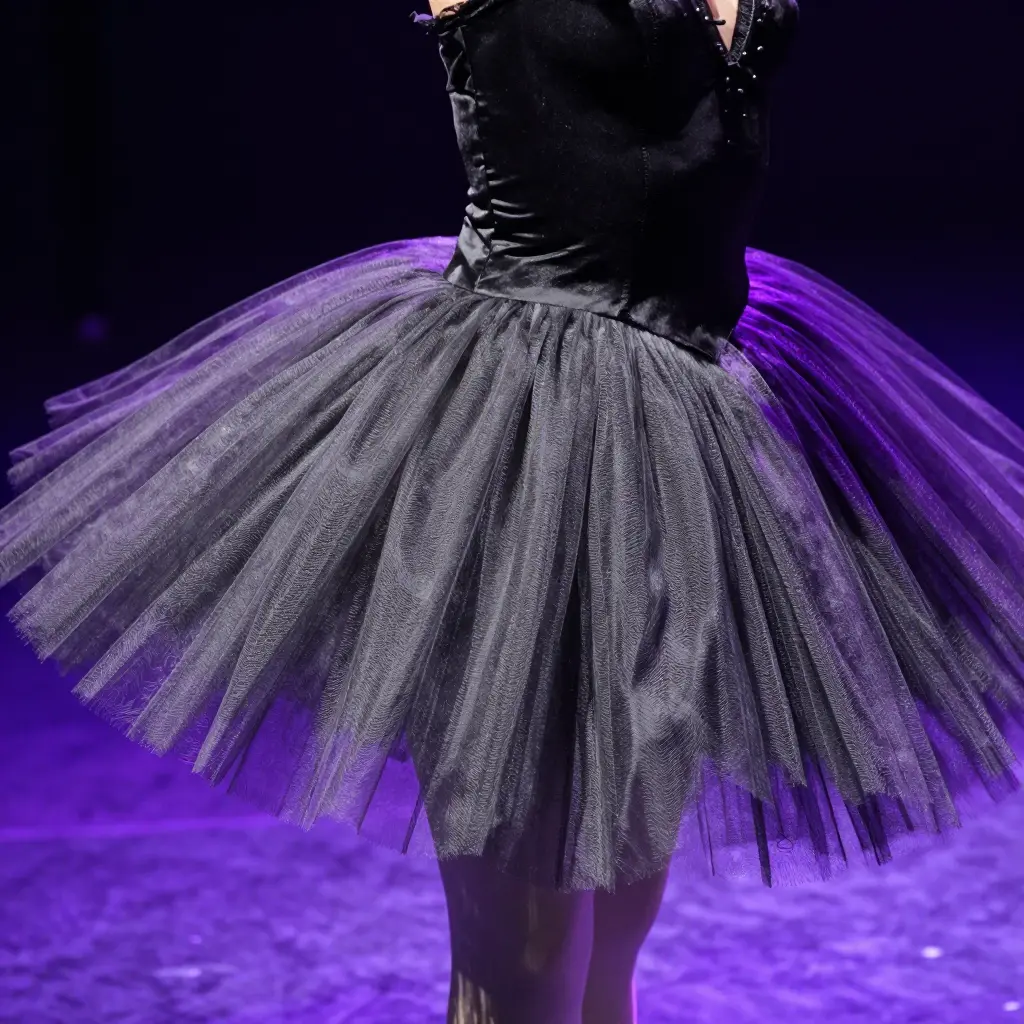
Dye Depth and Pigment Load in Black Tulle
Dye depth measures how far colourant travels into a fibre, which is not the same thing as how dark the surface looks. In black tulle it depends on two factors: how much dyestuff is in the bath, and how deeply it migrates into each nylon or polyester filament. The deeper it penetrates, the more light the fibre absorbs. Dye that stays near the surface leaves a paler, more reflective core.
Two fabrics can both be sold as “black” and still hold very different amounts of dye. A heavy pigment load saturates the filament through its cross-section; a lighter one coats the outer layer and leaves residual reflectance behind. Under stage light, that residue is what turns into grey or purple casts.
Weight and layer count change the maths again. A heavier tulle takes up more pigment per square metre, and layers compound the effect: several deeply dyed layers approach total absorption, while thin, lightly loaded layers pass light back and forth and brighten the silhouette. That relationship is the one to understand when you are balancing colour fidelity against cost – see this black tutu fashion guide for practical context.
How dye depth and fabric structure shape perceived colour under stage lights
| Fabric/Dye Condition | Typical Visual Under Neutral Light | Typical Visual Under Strong Stage Light | Practical Takeaway |
|---|---|---|---|
| Deep-dyed matte tulle | Rich, even, dense colour with almost no surface reflection | Holds its hue; stays dark and saturated with minimal grey or purple drift | The most reliable base for a true black read; the matte surface absorbs light instead of bouncing it |
| Lightly-dyed tulle | Pale, translucent colour that already looks thin where the mesh stretches | Colour drops out fast and can flare toward white or grey in the brightest beams | Avoid for solid dark looks; over-dye or layer heavily to build density |
| Layered tulle net | Depth builds with every layer, so the colour looks noticeably richer | Stacking raises opacity, but sheen bouncing between layers can grey out a black build | Control layer count and favour matte net; extra layers do not always equal deeper black |
| Hot-fixed/saturated black | Deep, flat black with a low-sheen, uniform finish | Resists the grey/purple shift and holds black even under hot, high-intensity beams | Hot-fixing locks dye into the fibre; treat this as the performance standard for black tulle |
| Shiny or glazed tulle | Glossy and reflective, so the colour looks brighter and more brilliant | Specular highlights flare to white or silver, making the colour read washed out | Matte finishes read truer; a glaze can betray black onstage by turning it silver |
Tulle Sheen: Specular versus Diffuse Reflectance
Tulle sheen comes from the way light leaves the surface. Specular reflectance is the mirror-like bounce off a smooth interface, where the angle of reflection equals the angle of incidence. Diffuse reflectance scatters light in many directions, so no single bright highlight forms.
Fibre and finish set the balance. Nylon and polyester have smooth, glassy polymer surfaces and reflect a large share of light specularly. The open mesh exposes a great deal of fibre edge as well, and every filament acts as a small cylindrical reflector.
A glossy, glazed finish on a nominally black tutu can throw a cool, bluish-white highlight back at the viewer, and the eye reads that as grey or faintly violet rather than black. Calendering and heat-setting make it worse; a matte finish keeps it down.
With a deep black dye, almost all transmitted light is absorbed, so what returns to the eye is mostly surface reflection. That is why sheen does so much of the work in how a black skirt reads. For more on how these construction choices play out on stage, see understanding tutu construction and fabric behaviour.
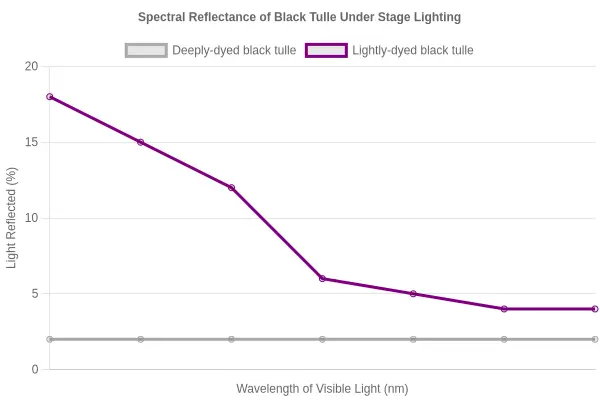
A shallow dye leaves the fibre only partly saturated, so it returns more light in the blue-violet region. That is where the violet-grey signature of a lightly-dyed black tutu comes from; the deeply-dyed sample stays near flat across the same spectrum.
How Backdrop Contrast Reshapes a Black Tutu
Backdrop contrast is the difference in luminance between a subject and the field behind it. The eye judges brightness by comparison rather than absolutely, so the set, cyc or backdrop behind a dancer changes how a black tutu looks – the effect known as simultaneous contrast.
The direction is predictable. On a bright backdrop the skirt reads darker and greyer, because the eye adapts to the high luminance and recalibrates black downward into charcoal. On a dark backdrop the same fabric appears to lift, and undertones of purple or blue come to the surface.
Colour adds to it. A coloured backdrop under coloured light pulls the perceived skirt colour toward a related or complementary hue: an amber wash can leave black looking violet, while a blue cyc can tint the mesh itself so the skirt reads navy.
Dancers train to read silhouette against all kinds of backdrops; our tutu school ballet program covers how.
How Light Behaves at the Tulle Layer
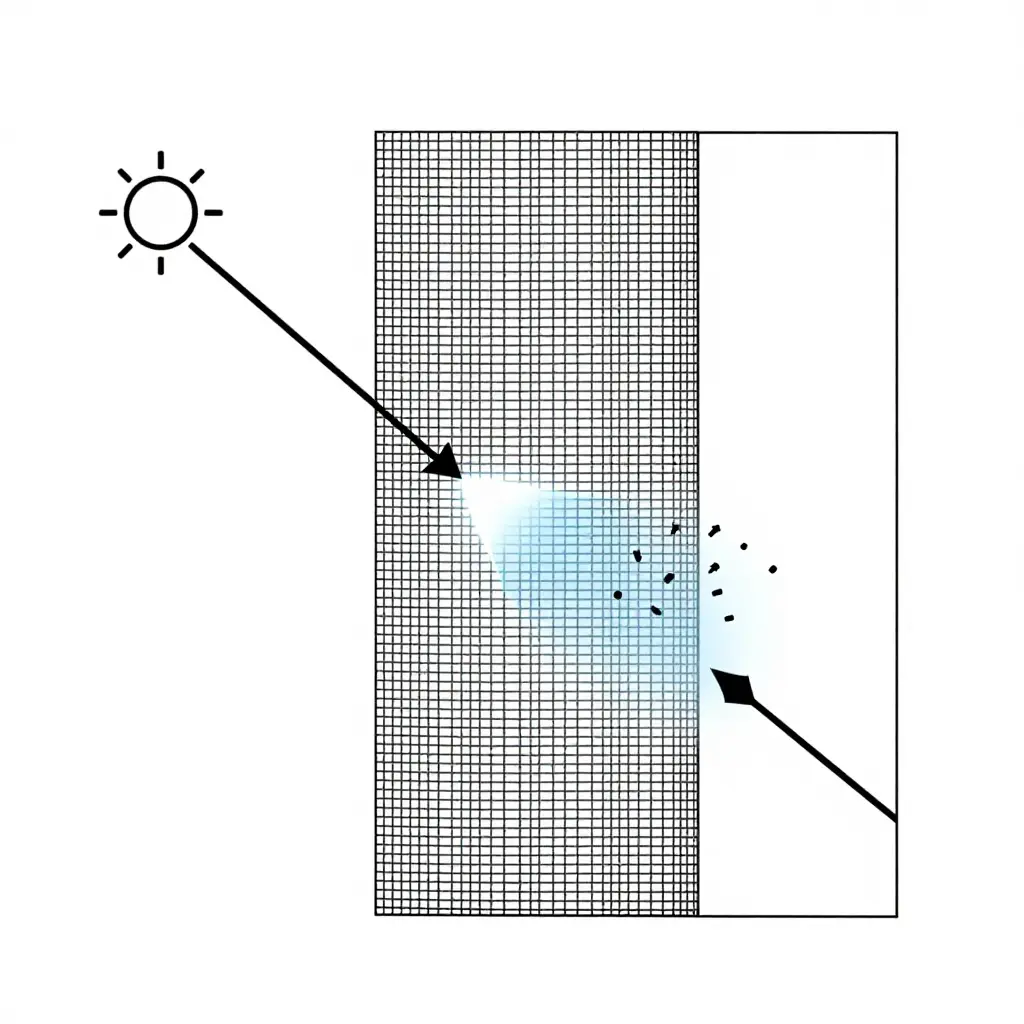
The incoming beam does not simply stop at the mesh. Part of it is absorbed into the fibre, a small mirror-like fraction bounces off the surface of individual filaments, a wider fan scatters diffusely, and the rest passes through the open mesh to land on the backdrop. The specular arrow is the tulle sheen that turns a dark skirt grey or faintly purple under a strong beam, and the split between absorbed and transmitted light is what dye depth controls: a shallow dye load lets more light through and lifts the apparent value. Read the arrows together and you can see why one black tutu reads matte, another silvery, another violet, depending on the source, the fibre surface and the backdrop. For a fuller look at how these effects play out on stage and in styling, see our black tutu fashion guide.
Practical checks before a black-tutu performance
Run this checklist with your costumier, wardrobe staff, choreographer and lighting team in the room, because a black tutu only performs as designed when everyone agrees on how light, dye and fabric interact.
- Confirm dye depth with a swatch under the actual fixture. Cut a scrap from the same dye lot as the black tutu and view it beneath the exact profile, fresnel or LED you will use on stage, since warm par cans and cool studio light can both push a deep black toward grey or purple.
- Choose matte finishes to reduce sheen. Favour matte tulle, matte net and matte trims over satin-faced or lustrous fabrics; specular reflections bounce white light back toward the audience and flatten the dancer’s silhouette. A guide to building a professional tutu will cover the trim choices in more detail.
- Rate the garment against the show backdrop. Stand the tutu directly in front of the painted or projected scenery and judge backdrop contrast, because a mid-grey cloth can swallow a black tutu whole while a bright cyc makes it separate cleanly.
- Plan fixture colour temperature. Decide in advance whether warm (3200 K) or cool (5600 K) sources will dress the dancer, then write the chosen gel or LED setting into the cue sheet before tech.
- Adjust backdrop luminance. Dim, black out or gel the backdrop so its brightness sits clearly above or below the tutu, keeping the costume edge legible from the last row of the house.
- Test layering. Show the full build under finished lighting – bodice, basque, tulle layers and trims together – because a single added satin layer can introduce a sheen nobody planned for.
- Brief the wardrobe team on lighting changes. Send revised colour temperatures, gel swaps and dimmer levels to costumes before the tech run, so quick fixes are sewn in the workroom rather than improvised backstage during the performance.
Conclusion: The Science Behind a Black Tutu on Stage
A black tutu rarely stays black once the rig is on. Dye depth decides how much pigment is there to absorb light, sheen decides how much bounces off the surface, and the backdrop decides what the eye compares it against. Move any one of the three and the colour on stage changes.
That is why the wardrobe and lighting teams need to work from the same information. A swatch from the actual dye lot, tested under the actual fixtures before opening night, is what makes the outcome predictable instead of accidental.
So choose well-dyed balletwear you can trust, and check it under your own lights. Explore our complete ballet ballerina tutu guide to make every entrance look exactly as intended.