
What Is the Tutu Twirl Test?
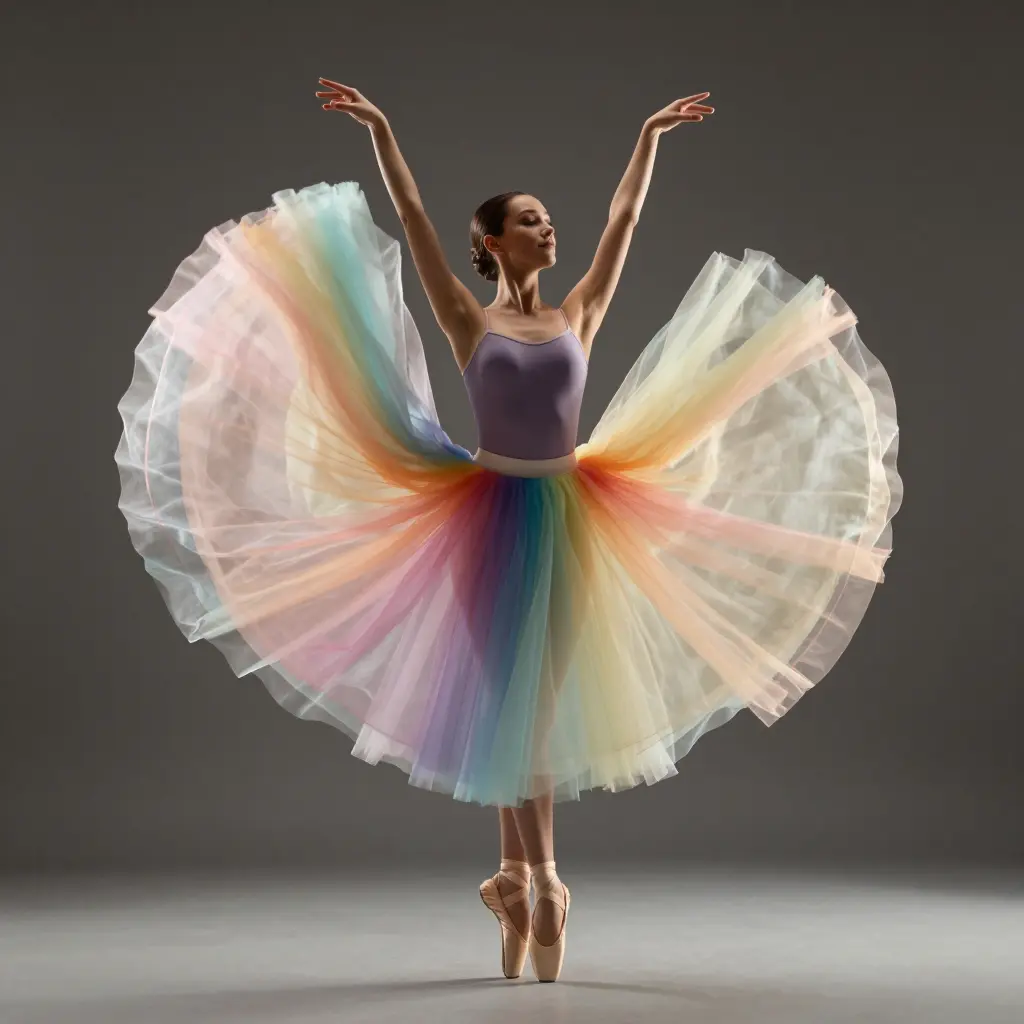
The tutu twirl test measures how long and how smoothly a skirt keeps rotating after a dancer turns. Instead of the vague impression of “this tutu feels nice to spin in”, it gives you something you can watch, time, and compare. In a pirouette or a run of turns, the skirt does not simply follow the body: it lags, flares, holds its shape, then settles. The test is built to capture that whole arc of motion.
Two variables shape the results more than any others: layer count and tulle weight. Layer count is how many tiers or panels of tulle make up the skirt. Tulle weight describes the density and stiffness of the fabric itself. Together they govern spin dynamics – how a skirt accelerates, holds its form mid-turn, and coasts to a stop. Change either one, and the motion changes with it.
More layers add body and volume, which can keep the fabric moving longer, but they also add drag and mass. Heavier tulle resists flutter and holds a wide, crisp silhouette, while lighter tulle flares easily and settles quickly. The twirl test is how you find the balance between those forces.
A skirt’s spin is not accidental. It follows from how many layers you use and how heavy the tulle is, and the twirl test measures that relationship directly.
For background on how tutus are built, from basque waistlines to pancake shapes and the tulle choices behind them, our ballet tutu guide is a useful companion read.
How Layer Count Changes the Spin
Layer count is the biggest lever a dancer or costume maker can pull to change how a skirt behaves in motion. Every extra layer of tulle adds mass, not just fullness, and where that mass sits matters more than most people expect.
Think of rotational inertia as a skirt’s resistance to speeding up or slowing down. Move mass away from the body’s central axis and it rises. A layer stitched tight against the hip sits close to that axis; a gathered pancake layer flares outward and puts its weight far from the center. The farther out the tulle sits, the harder the skirt is to start spinning, and the harder it is to stop.
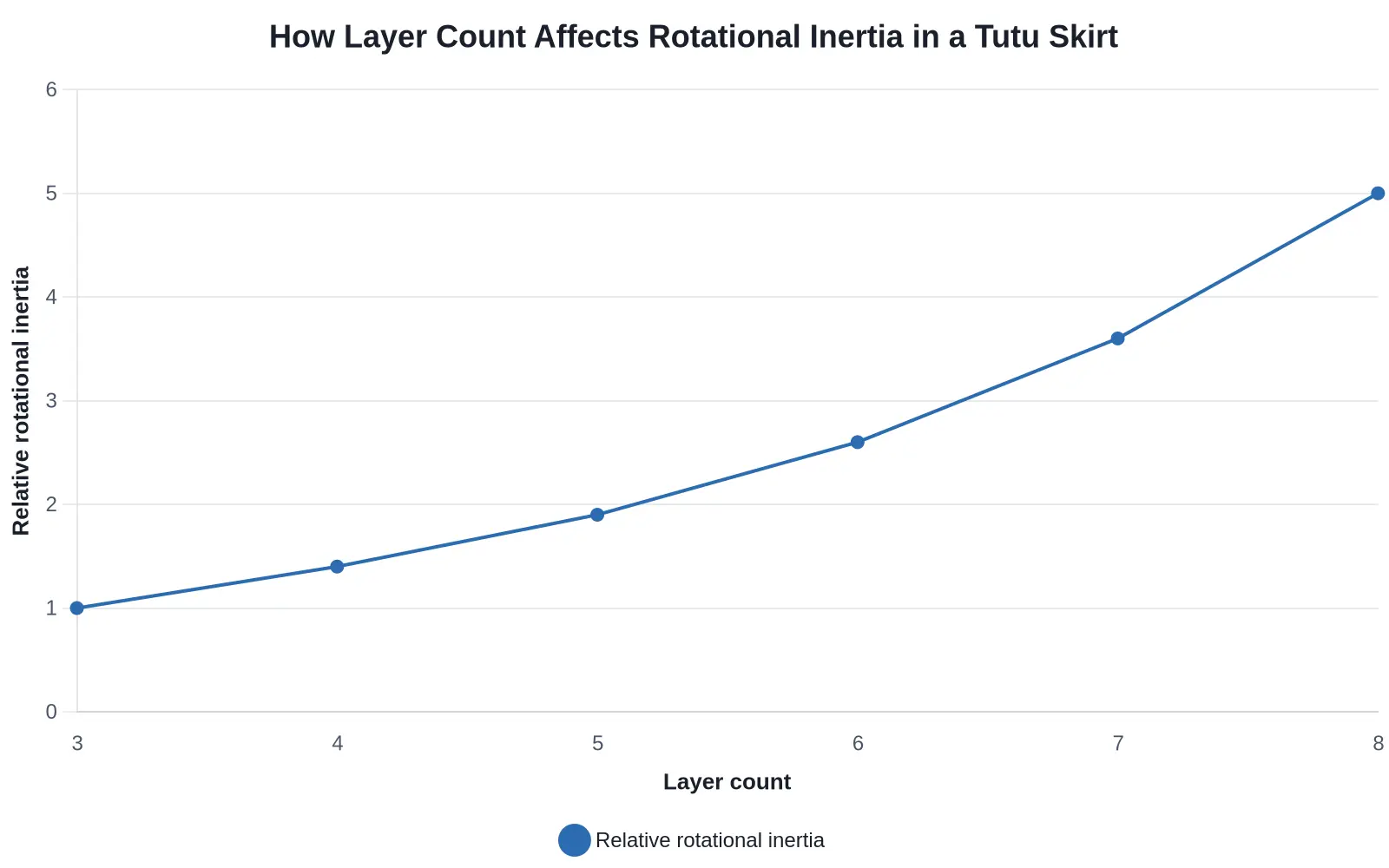
That is why layer count reshapes the feel of a turn:
- More layers add mass away from the body’s axis, raising rotational inertia.
- A higher layer count increases stiffness, so the skirt holds a flat, disc-like shape.
- Fewer layers keep the skirt soft, letting it collapse and react quickly to the body.
Six layers vs. three layers
A six-layer pancake tutu and a lighter three-layer skirt show the contrast clearly. The six-layer version carries noticeably more weight spread across stiff, flat rings, so it spins like a heavy flywheel: it glides smoothly and keeps rotating even after the dancer’s body slows. The three-layer skirt feels light and lively, but its spin fades quickly because less momentum is stored in it.
Parents often notice the difference as a skirt that “keeps going” versus one that stalls the moment the turn ends. Costume makers can tune that outcome just by adjusting layer count.
For a closer look at how these construction choices play out in performance, explore tutu and skirt construction insights.
Table 1. How tulle weight dictates layer count and twirl behavior. Pairing the right fabric with the right number of layers decides whether a skirt flutters or holds its shape.
| Tulle Type | Approximate Weight Classification | Typical Layer Count | Stiffness | Effect on Spin |
|---|---|---|---|---|
| Soft, fine tulle (silk tulle, fine English net) | Lightweight (very low gsm) | 10-20 layers (Romantic tutus) | Low | Layers drape and flutter outward slowly, producing a soft, floating spin with gentle, organic movement |
| Medium-stiffness tulle (standard nylon or cotton tulle) | Medium weight | 6-10 layers (Classical tutus) | Medium | Balanced lift and drape; the skirt flares responsively and recovers quickly, giving a clean, controlled spin |
| Stiff netting / crinoline (stiffened or starched tulle) | Heavy and rigid | 4-8 layers (pancake and plate tutus) | High | Rigid disc holds a flat, horizontal shape and stays aerodynamic, delivering a fast, dramatic, and highly stable twirl |
Lighter tulle needs more layers to build volume, while stiffer fabric reaches a dramatic silhouette with far fewer. That trade-off is why a Romantic tutu feels airy and slow while a pancake tutu snaps into a sharp, self-supporting disc during a fast pirouette. For a closer look at how these skirt constructions come together, explore our guide to tutu dress and skirt insights.
Understanding Tulle Weight
Tulle weight describes how dense, firm, and substantial a length of mesh feels – its mass per area plus the stiffness that comes with it. Run featherlight fine tulle between your fingers and it behaves like smoke: translucent, airy, ready to drift into soft folds. Lift a panel of heavy stiff netting instead and it stands up on its own, resists gravity, and springs back when you press it. On stage, that one variable shapes drape, hold, and air resistance.
Drape, Hold, and Air
Lighter tulle drapes softly, so the layers fall close to the leg and read as delicate and romantic. Heavier tulle holds its shape instead of collapsing, which is why a stiff skirt plate stays flat and horizontal. During a spin, the skirt meets moving air: light tulle slips through with little resistance and settles almost as fast, while heavy tulle catches the air, resists it, and keeps turning.
Tulle Categories by Weight
| Category | Feel in hand | On a skirt |
|---|---|---|
| Featherlight fine tulle | Sheer, silky, barely there | Soft drape, floats and settles fast |
| Light / soft tulle | Airy but slightly firmer | Gentle volume, easy movement |
| Medium tulle | Noticeable body | Holds shape with some bounce |
| Stiff / heavy netting | Rigid, crisp, scratchy | Flat plate, strong hold, slow to settle |
Why Heavier Tulle Carries Momentum
More mass per unit area means more rotational inertia. A skirt built from heavy tulle keeps spinning longer after the dancer stops driving it, which is the look many classical tutus chase. The same physics works against the dancer, though: a heavy skirt is harder to start, harder to accelerate, and tiring to carry through a long variation.
Because that mass rests on the hips, extra tulle weight adds to the effort of every turn and jump. The craft is in balancing the two – enough weight for a satisfying spin, little enough to stay comfortable. For more on how tutus are built, our ballet tutu guide is worth reading.
How a Tutu Is Built: A Cross-Section of Layers
Before we talk about spin speed, it helps to picture what is actually spinning. A tutu is not a single skirt but a stack of engineered layers, each doing a specific job. The diagram below breaks the construction down from top to bottom: the structured waistband that anchors everything, the stacked tulle layers that create volume and stiffness, and the outer tacked layer that locks the silhouette together.
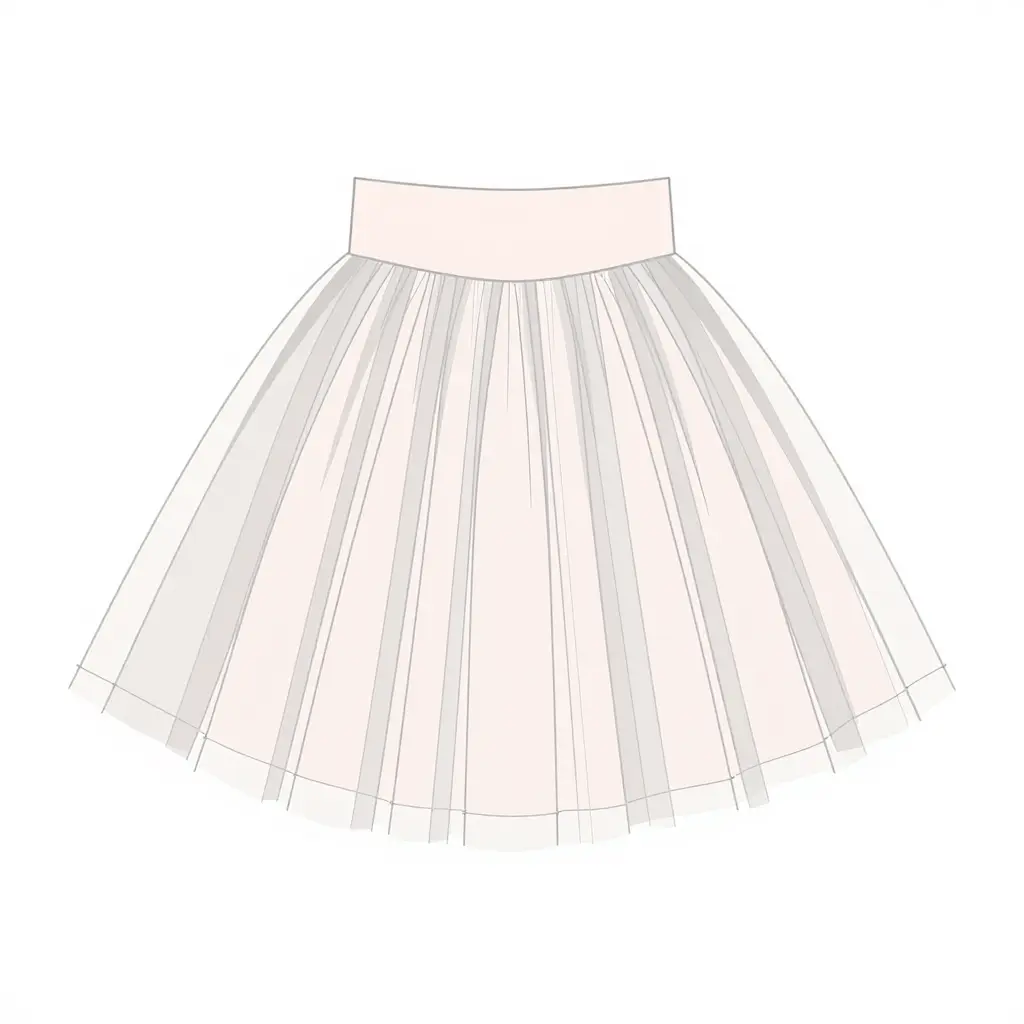
Read it as a map, not a photo. The horizontal band at the top is the waistband. The parallel curved lines fanning outward and downward are individual tulle layers, each cut progressively longer to build the classic tutu profile. The outermost curve, held with small stitch marks at intervals, is the tacked layer that keeps the skirt from separating mid-pirouette. For a fuller walkthrough of skirt construction, explore our guide to tutu dress and skirt insights.
The Physics of Spin Dynamics in a Tutu
When a dancer stops turning, the tutu rarely stops with her. The skirt keeps rotating for a moment, drifting past the body before it settles. That lag comes directly from spin dynamics – the way a rotating object stores, carries, and releases turning motion.
Angular momentum describes how much spin a body holds. Two factors set its size: the rotation speed and how far the object’s mass sits from the central axis. That second factor is rotational inertia, sometimes called the moment of inertia.
Picture two objects of identical weight – one a compact sphere, the other a wide, thin hoop. Spin both at the same rate and the hoop is far harder to stop, because its mass is spread farther from the center and it resists any change to its motion.
A tutu behaves like a stack of hoops. Fabric sitting close to the waist contributes little to rotational inertia, while tulle that flares outward places mass at a larger radius. The farther that fabric sits from the axis, the greater the inertia – and the longer the skirt keeps spinning after the dancer slows.
Air resistance pushes in the opposite direction. Every layer of tulle adds surface area, and that surface catches air, creating drag that bleeds spin away. Heavier tulle carries more momentum but also more drag, so extra weight rarely translates into endless rotation. This tension between stored momentum and drag is exactly what the tutu twirl test measures.
Layer Count and Tulle Weight as the Controls
These two variables decide how a skirt performs. Adding layers increases both the distributed mass and the drag, so spin duration tends to rise to a peak and then fall. Lighter tulle lets you add layers for volume without overwhelming the inertia-to-drag balance. Heavier tulle gives each layer more presence, so fewer layers can deliver similar momentum.
That balance drives most decisions about choosing and building skirts. For a closer look at how tulle layers and skirt construction affect movement, explore this guide to how tulle layers shape skirt performance.
Spin Duration by Layer Count: Finding the Sweet Spot
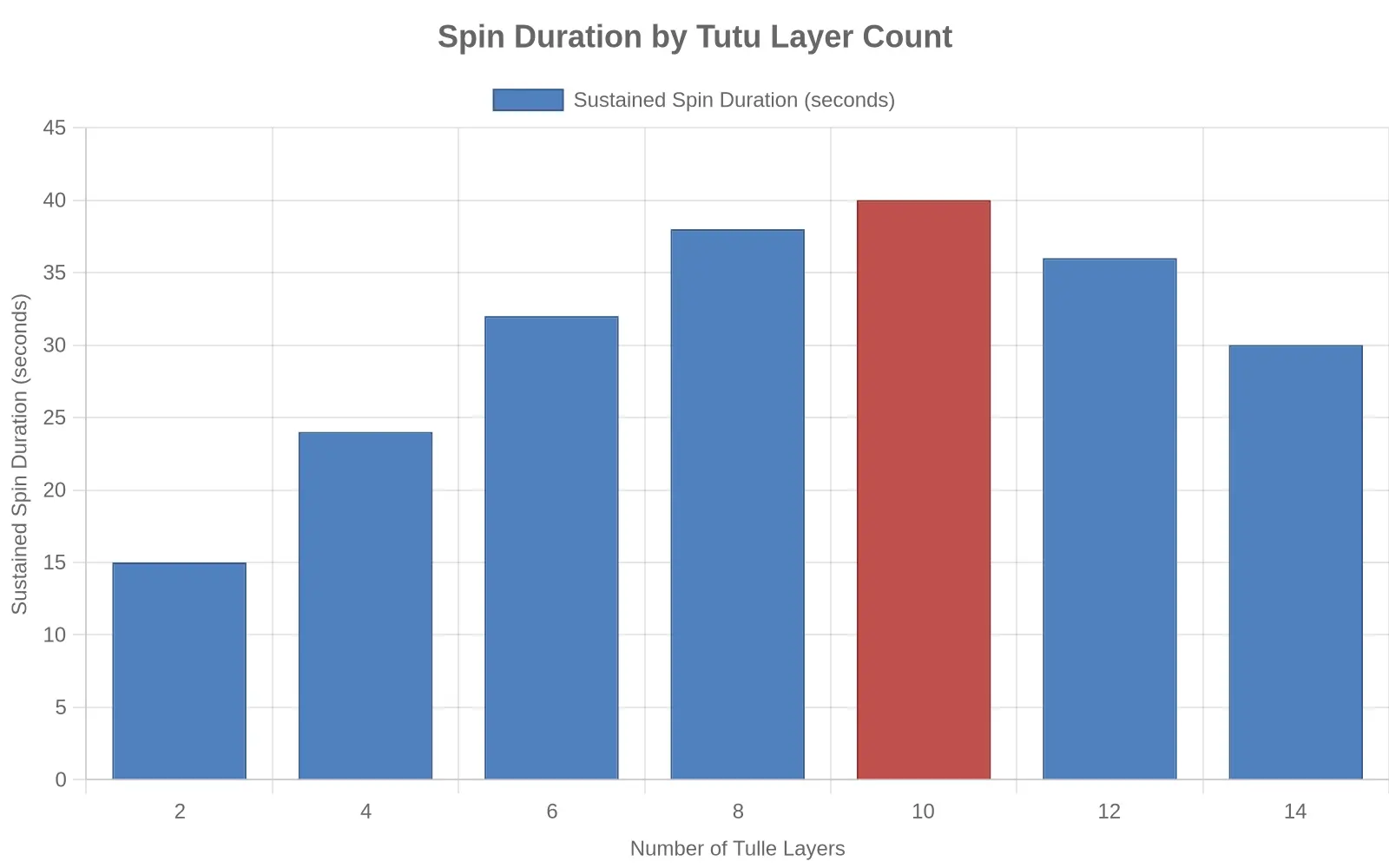
Adding layers builds momentum, but only up to a point. Spin duration climbs steadily from 15 seconds at two layers to a peak of 40 seconds at ten layers, then plateaus and slips to 30 seconds at fourteen layers as the extra tulle starts working against the turn.
Caption: The balance point between layer count and spin performance: the optimal spin sits where added volume and rotational stability stop outweighing excess skirt weight.
The goal is margin, not maximum. The rise from 2 to 8 layers reflects the volume and air resistance that help a skirt hold its shape mid-turn, while the drop past 10 layers shows that more fabric eventually becomes drag rather than drive. If you want to see how construction choices shape that balance, these tutu dress and skirt insights walk through the design decisions behind a well-tuned skirt.
Finding the Balance Between Weight and Layers
Once you understand spin dynamics – how mass, radius, and momentum keep a tutu rotating – the real decision is how to pair tulle weight with layer count. The two variables never work alone. A skirt built from a few layers of heavy tulle behaves very differently from one made of many layers of fine, lightweight netting, and neither option is automatically the better choice.
The relationship is not linear. Adding layers increases rotational inertia, so the skirt carries more momentum and settles more slowly. That gain rises quickly at first, then flattens. Somewhere in the middle, every extra layer starts adding weight and bulk far faster than it adds usable spin.
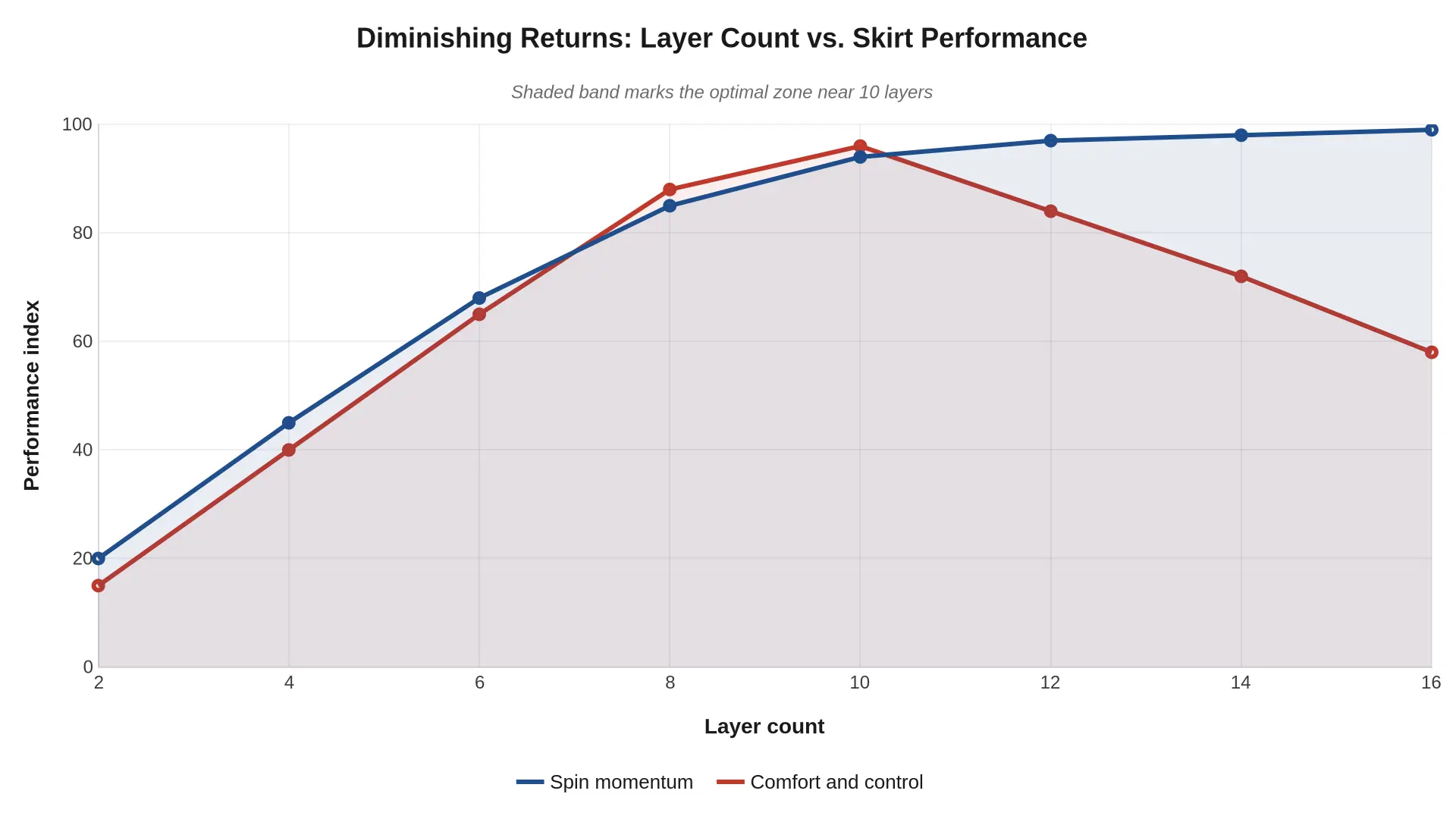
Where Momentum Stops Paying Off
This is the point of diminishing returns, and it is worth understanding before you choose a tulle weight and layer count.
- Momentum gains level off once the skirt is heavy enough to hold its own shape through a turn.
- Comfort drops as extra weight presses on the waist, hips, and lower back over a long class or performance.
- Control suffers because a very heavy skirt resists quick stops, tight turns, and sudden direction changes.
- Durability can fall if stiff, heavy tulle creases or tears at stress points, while very light tulle may collapse and flatten with wear.
In practice, a moderate layer count paired with a medium tulle weight gives most dancers the best blend of glide and control, while extreme options trade one quality for another.
Choosing the Right Combination
Different users weigh these trade-offs differently, so the ideal pairing depends on how the skirt will be used.
- Dancers: prioritize a combination that spins cleanly without pulling you off balance. Medium-weight tulle and a measured layer count usually keep momentum predictable during turns. Dancers upgrading a performance piece can review an adult tutu guide for fit and construction choices.
- Students and parents: weigh durability and easy care, since practice skirts take repeated use and washing. A slightly denser tulle with fewer layers often outlasts a delicate, many-layered skirt.
- Costume makers: prototype before committing to a final build. Adjust the tulle weight and layer count on a sample, then compare how each version moves before scaling up production.
The most reliable check is the tutu twirl test: spin the finished skirt and watch how it settles, how long the rotation lasts, and whether the weight feels balanced at the waist. Running the test on two or three combinations reveals the point of diminishing returns for your specific design, rather than relying on guesswork. For a broader look at how construction shapes performance, see this guide to tutu styles and structure.
Balance, not excess, is what makes a skirt spin well and stay comfortable. The twirl test turns that idea into choices you can act on:
- Match tutu layer count to dance level so the skirt supports the choreography instead of fighting it – beginners usually thrive with 4-6 soft layers, while advanced classical roles may call for 10 or more stiffened layers to form that flat, dramatic plate.
- Select tulle weight to suit your intended effect: fine soft tulle delivers airy bounce, medium tulle handles everyday rehearsal wear, and heavyweight stiff tulle builds a rigid classical silhouette that barely moves.
- Check waistband support first, because a wide, firm basque or reinforced elastic band keeps the tutu anchored through turns, jumps, and lifts without sagging or twisting.
- Test the spin before a performance by doing a full twirl and watching how the skirt opens, settles, and returns to rest – if it lags or wobbles, adjust the layers or length now.
- Balance lift with control, since a tutu that flares out but off-center will pull the dancer’s balance and reveal itself under stage lights.
- Verify tulle recovery by scrunching a test layer: quality tulle snaps back flat, while cheap tulle stays creased and droopy after pressure.
- Tune hem length and shape to suit the leg line – a slightly longer hem can steady a spin, while a very short plate reads as faster and sharper onstage.
- Ask a teacher or partner to watch the twirl test from the front and side, catching asymmetry that a spinning dancer simply cannot feel.
For a deeper breakdown of layering and construction, explore our complete ballet tutu guide.
Which Factors Actually Keep a Skirt Spinning?
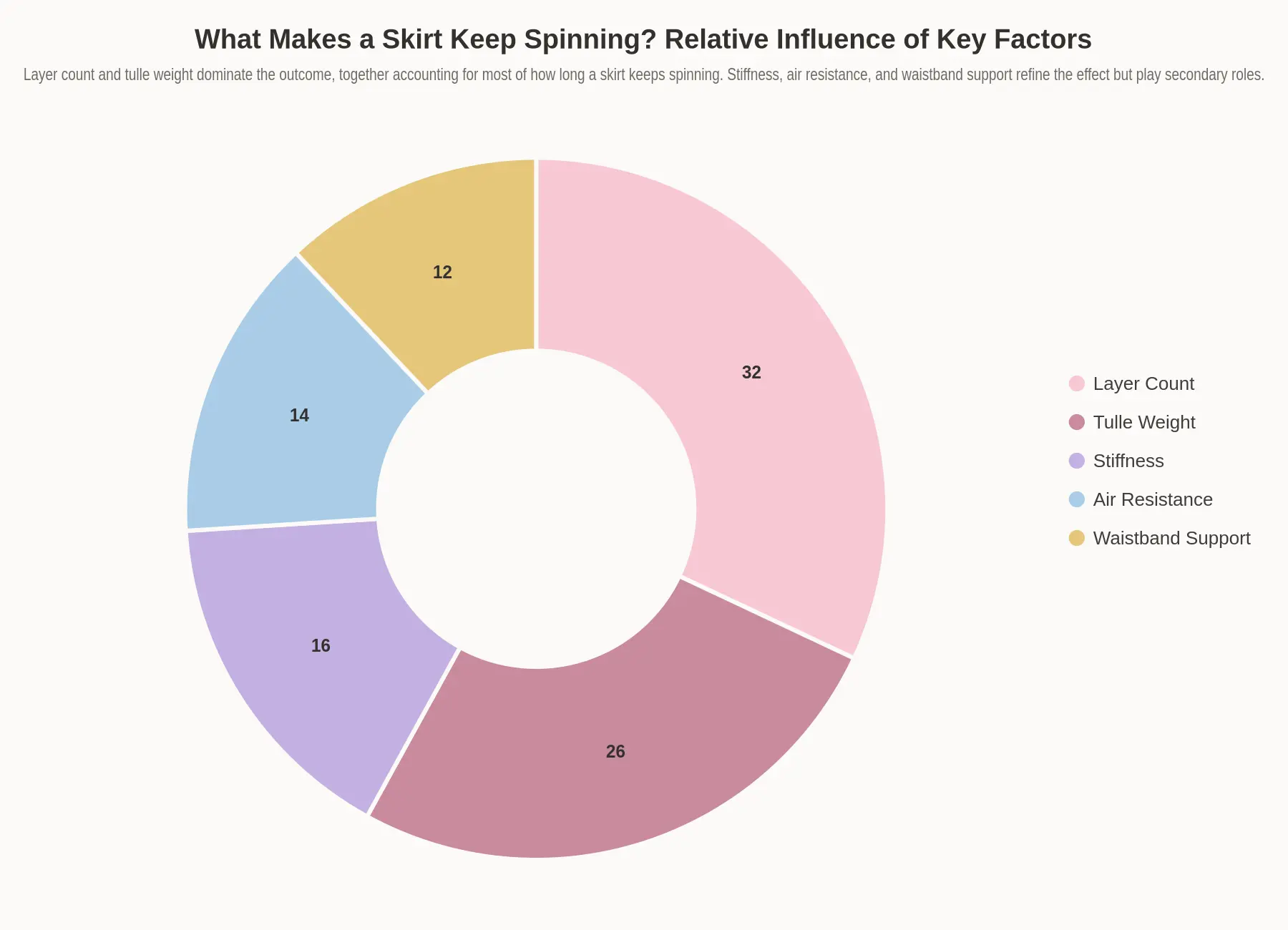
Layer count and tulle weight dominate the outcome, together accounting for the majority of how long a skirt keeps spinning. Stiffness, air resistance, and waistband support refine the effect, but they play secondary roles.
The chart breaks down the relative contribution of each variable on its own terms:
| Factor | Relative Influence |
|---|---|
| Layer Count | 32% |
| Tulle Weight | 26% |
| Stiffness (fabric body / starch) | 16% |
| Air Resistance (drag & surface area) | 14% |
| Waistband Support (security & weight distribution) | 12% |
The two structural choices dominate the pie: how many layers you build and how heavy that tulle is together drive roughly 58% of the spin performance. Refinement details like starch stiffness or a snug waistband matter, and you can explore them further in our complete ballet tutu guide, but they cannot rescue a skirt whose core construction is off. Build the layers and weight right first, then tune the rest.
Tutu Layer Count and Tulle Weight: Frequently Asked Questions
How many layers does a tutu need to spin well?
A skirt generally needs at least four to six layers of tulle to hold a rounded shape and keep momentum through a turn. Fewer layers feel light and collapse quickly, while eight to twelve layers give a fuller, more stable disc that carries energy through multiple rotations. The exact number depends on the stiffness of the tulle and the size of the dancer, so layer count and tulle weight should be tuned together rather than in isolation.
Does heavier tulle make a skirt spin longer?
Heavier tulle adds mass, and greater mass means higher rotational inertia, so a skirt keeps spinning longer once it is already moving. The trade-off is that heavier fabric takes more force to start turning and can make quick direction changes sluggish. Mid-weight tulle usually offers the best balance, storing enough energy to extend the spin without dragging on the dancer’s movement.
What is the best tulle weight for a beginner?
Beginners are best served by a light to medium-weight tulle, roughly a soft bridal or mid-stiffness craft grade. This weight is forgiving to sew, comfortable for young dancers, and still stiff enough to form a recognizable bell shape with five or six layers. Very stiff tulle can scratch and crack, while very soft tulle needs many more layers before it looks full.
How do I test the twirl of a tutu before buying?
Do a simple tutu twirl test: hold the skirt at the waistband, lift it to arm’s length, and spin yourself once. Watch whether the layers flare evenly and whether the hem keeps rotating after you stop. Count the seconds of continued movement and check for sagging or flat spots. A skirt that holds a smooth disc and coasts for two or three seconds after you stop is well balanced. For a deeper look at construction details, see our tutu dress and skirt insights.
Does a higher layer count always mean a better spin?
No. Beyond roughly twelve layers, the added fabric increases weight and drag more than it improves momentum, and the skirt can start to look bulky. Balance is the goal: enough layers to hold shape, matched to a tulle weight that stores energy without fighting the dancer.
Bringing the Twirl Test Together
Three things matter most in the twirl test. First, layer count controls rotational inertia: more layers push mass outward from the axis of rotation, which slows the spin down but stretches it into a longer, more graceful glide. Second, tulle weight affects both momentum and comfort: heavier fabrics carry a spin further but can drag on the body, while lighter tulle feels airy yet may flutter rather than hold a crisp line. Third, spin dynamics are the result of their balance – neither layers nor weight mean much on their own, because how they combine determines whether a skirt turns with you or fights against you.
A dancer who understands how her skirt is built can choose the combination that matches her movement, her role, and her body, and that choice shows in her confidence on stage. At luneballet.com, the aim is balletwear that supports movement and confidence – garments designed to work with a dancer, not against her. The site’s library goes deeper into layer selection, tulle types, and skirt construction.
The twirl test is less a single measurement than a habit: judge each skirt by how its layers and tulle weight balance against each other, and you will know what to expect when the music starts.